# Project Deck Cover — Subject Above the Issue Record
Produce one slide to the following specification.

- Canvas 1920 × 1080
- Margin top 116 right 140 bottom 116 left 140

## Type (px against a 1920px canvas)
doctype  20px / 700 / tracking 0.08em
edition  17px / 400 / tracking 0.04em / tabular numerals
kicker  15px / 500 / tracking 0.3em / uppercase
title  84px / 700 / tracking 0.01em / leading 1.28
lede  20px / 400 / leading 1.9
label  14px / 500 / tracking 0.14em
value  21px / 500 / tabular numerals

## Colour
Ground #111722 / Surface #1A2231 / Ink #E9EDF4 / Muted #8894A6 / Accent #5AA2E8 / Rule #2B3445

## Constraints — dropping these breaks it
- Keep the four issue fields — a project deck goes out many times under the same subject, and without version, date and recipient no one can tell which copy they hold
- The document type is the one thing allowed to be read before the subject: a small filled box, separated from the subject by size rather than position
- Colour only the second line of the subject — the first names the project, the second names what this deck covers
- Never pure white on a dark ground — the cover stays on screen longer than any other slide

Replace the content with [your content]. Keep the measurements and colours as given.
For an exact reproduction, use the verbatim HTML at https://design-vault.pages.dev/designs/deck-cover-project-brief/pattern.html.

---

# Agenda — Each Section Carries What It Asks For
Produce one slide to the following specification.

- Canvas 1920 × 1080
- Margin top 112 right 140 bottom 112 left 140
- 2 equal columns, gap 104

## Type (px against a 1920px canvas)
kicker  15px / 500 / tracking 0.28em / uppercase
title  56px / 700 / tracking 0.01em / leading 1.3
mkey  15px / 500 / tracking 0.12em
mval  17px / 500 / leading 1.65 / tabular numerals
note  17px / 400 / leading 1.9
num  30px / 700 / tabular numerals
name  30px / 500 / leading 1.45
goal  16px / 400 / leading 1.7

## Colour
Ground #FFFFFF / Surface #F4F6F9 / Ink #131820 / Muted #667183 / Accent #1F5FA8 / Rule #DBE1E9

## Constraints — dropping these breaks it
- Put the decision each section seeks beside its name — an agenda without it is a timetable, and the room cannot tell how to listen
- Dim the sections you will not cover rather than removing them — removed reads as absent, and sends people hunting in the appendix
- Keep the session facts on the same page as the sections; on a separate slide nobody remembers when the meeting ends
- Two-digit numbers throughout — mixing one and two digits breaks the left edge the list is read down

Replace the content with [your content]. Keep the measurements and colours as given.
For an exact reproduction, use the verbatim HTML at https://design-vault.pages.dev/designs/agenda-numbered-sections/pattern.html.

---

# Scope Boundary — In and Out at the Same Size
Produce one slide to the following specification.

- Canvas 1920 × 1080
- Margin top 108 right 140 bottom 108 left 140
- 2 equal columns, gap 64

## Emphasis
column 1 only, by rule and nothing else

## Type (px against a 1920px canvas)
title  48px / 700 / tracking 0.01em / leading 1.3
lede  19px / 400 / leading 1.8
side  16px / 500 / tracking 0.18em / uppercase
heading  34px / 700 / leading 1.35
item  20px / 500 / leading 1.5
why  16px / 400 / leading 1.75
foot  17px / 500

## Colour
Ground #FFFFFF / Surface #F4F6F9 / Ink #131820 / Muted #667183 / Accent #1F5FA8 / Rule #DBE1E9

## Constraints — dropping these breaks it
- Keep the two fields equal — a smaller out-of-scope reads as unimportant and comes back later as "we assumed it was included"
- Match the counts too; three items against seven looks like one side was not thought about
- Give every out-of-scope item a when — without a date it reads as a refusal, not a sequence
- Emphasis is the rule colour alone — fill both fields and the boundary, which is the whole point, disappears

Replace the content with [your content]. Keep the measurements and colours as given.
For an exact reproduction, use the verbatim HTML at https://design-vault.pages.dev/designs/scope-in-out-two-fields/pattern.html.

---

# Phase Divider — The Whole Process, With a Mark on Now
Produce one slide to the following specification.

- Canvas 1920 × 1080
- Margin top 124 right 140 bottom 124 left 140
- 7 equal columns, gap 24

## Emphasis
column 4 only, by rule + weight and nothing else

## Type (px against a 1920px canvas)
chapter  15px / 500 / tracking 0.3em / uppercase
of  15px / 400 / tracking 0.12em / tabular numerals
num  136px / 700 / leading 1 / tabular numerals
title  68px / 700 / tracking 0.01em / leading 1.3
lede  20px / 400 / leading 1.9
phase  18px / 500
when  14px / 400 / tabular numerals

## Colour
Ground #111722 / Ink #E9EDF4 / Muted #8894A6 / Accent #5AA2E8 / Rule #2B3445

## Constraints — dropping these breaks it
- Keep the phases equal in width — encoding duration as width reads as slippage
- Mark the current phase with the rule and the weight, no fill — a filled band makes this read as a schedule rather than a divider
- Do not dim the finished phases; an unbroken row is what says the whole process is still in view
- The section number and the phase rail are different axes — never renumber one to match the other

Replace the content with [your content]. Keep the measurements and colours as given.
For an exact reproduction, use the verbatim HTML at https://design-vault.pages.dev/designs/phase-divider-step-rail/pattern.html.

---

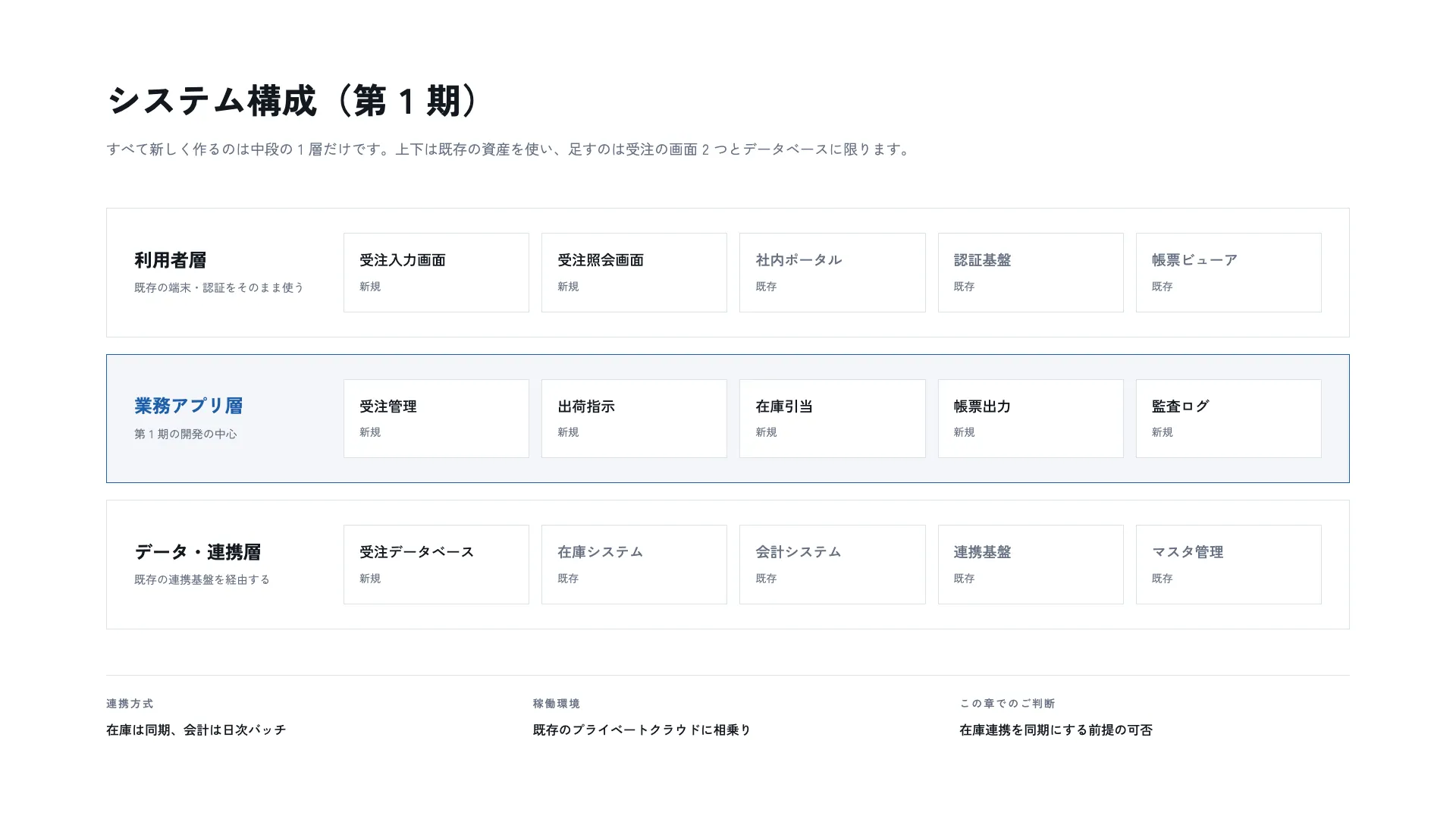
# System Architecture — Three Tiers, One of Them New
Produce one slide to the following specification.

- Canvas 1920 × 1080
- Margin top 104 right 140 bottom 104 left 140

## Emphasis
row 2 only, by fill + rule and nothing else

## Type (px against a 1920px canvas)
title  46px / 700 / tracking 0.01em / leading 1.3
lede  19px / 400 / leading 1.8
tname  24px / 700 / leading 1.4
tnote  15px / 400 / leading 1.6
bname  19px / 500 / leading 1.4
btag  14px / 400
fkey  14px / 500 / tracking 0.14em
fval  17px / 500 / leading 1.6

## Colour
Ground #FFFFFF / Surface #F4F6F9 / Ink #131820 / Muted #667183 / Accent #1F5FA8 / Rule #DBE1E9

## Constraints — dropping these breaks it
- Three tiers at most — a fourth makes the room memorise names instead of hearing which part you are building
- Fill only the tier that is new throughout; mark additions elsewhere on the boxes. Filling every tier reads as a full rebuild, and the cost conversation starts there
- Never dash the existing systems — a dashed box reads as undecided. Dim the label instead; these are the settled parts
- Five boxes per tier. From the sixth on, what the room remembers is the count, not the names
- State the integration style in one line at the foot; drawn as arrows it costs more time to explain than it saves

Replace the content with [your content]. Keep the measurements and colours as given.
For an exact reproduction, use the verbatim HTML at https://design-vault.pages.dev/designs/architecture-3tier-stack/pattern.html.

---

# Requirement Responses — Only the Alternative Is Filled
Produce one slide to the following specification.

- Canvas 1920 × 1080
- Margin top 104 right 140 bottom 104 left 140

## Emphasis
row 3 only, by fill + weight and nothing else

## Type (px against a 1920px canvas)
title  44px / 700 / tracking 0.01em / leading 1.3
count  17px / 400 / tabular numerals
col  15px / 500 / tracking 0.12em
rid  19px / 500 / tabular numerals
req  21px / 500 / leading 1.5
verdict  17px / 500
how  17px / 400 / leading 1.7
when  17px / 400
foot  16px / 400 / leading 1.8

## Colour
Ground #FFFFFF / Surface #F4F6F9 / Ink #131820 / Muted #667183 / Accent #1F5FA8 / Rule #DBE1E9

## Constraints — dropping these breaks it
- Three verdicts only — met, alternative, next phase. "Met with conditions" gets agreed to without the conditions ever being read
- Fill only the alternative row; filling the met rows makes the whole table emphasis and buries the one row worth discussing
- Keep the means in the same row — sent to an annex, "alternative" travels alone and nobody can say what changed
- If it is an extract, say so beside the title — six of forty-eight is a different slide from six of six
- Carry the client's own requirement IDs unchanged; renumbering costs a lookup in every later exchange

Replace the content with [your content]. Keep the measurements and colours as given.
For an exact reproduction, use the verbatim HTML at https://design-vault.pages.dev/designs/requirements-response-table/pattern.html.

---

# Team Structure — One Place to Decide, One Joint Desk
Produce one slide to the following specification.

- Canvas 1920 × 1080
- Margin top 100 right 140 bottom 100 left 140

## Emphasis
row 2 only, by fill + rule and nothing else

## Type (px against a 1920px canvas)
title  46px / 700 / tracking 0.01em / leading 1.3
lede  19px / 400 / leading 1.8
role  15px / 500 / tracking 0.12em
who  26px / 700 / leading 1.35
cadence  15px / 400 / tabular numerals
tname  22px / 700 / leading 1.4
tside  14px / 500 / tracking 0.12em
heads  15px / 400 / leading 1.8 / tabular numerals
foot  16px / 400 / leading 1.8

## Colour
Ground #FFFFFF / Surface #F4F6F9 / Ink #131820 / Muted #667183 / Accent #1F5FA8 / Rule #DBE1E9

## Constraints — dropping these breaks it
- Name forums, not people — an org chart made of names goes stale the first time someone rotates off
- Fill exactly one desk. Two filled desks means there is no desk
- Give each node its cadence: a monthly decision and a twice-weekly consultation are different organs
- Stop the connector at the outermost team's centre — run it to the margin and the chart implies more teams off-page
- Say who leads each team. A box with no lead is the one nobody claims when it matters

Replace the content with [your content]. Keep the measurements and colours as given.
For an exact reproduction, use the verbatim HTML at https://design-vault.pages.dev/designs/team-structure-joint-pmo/pattern.html.

---

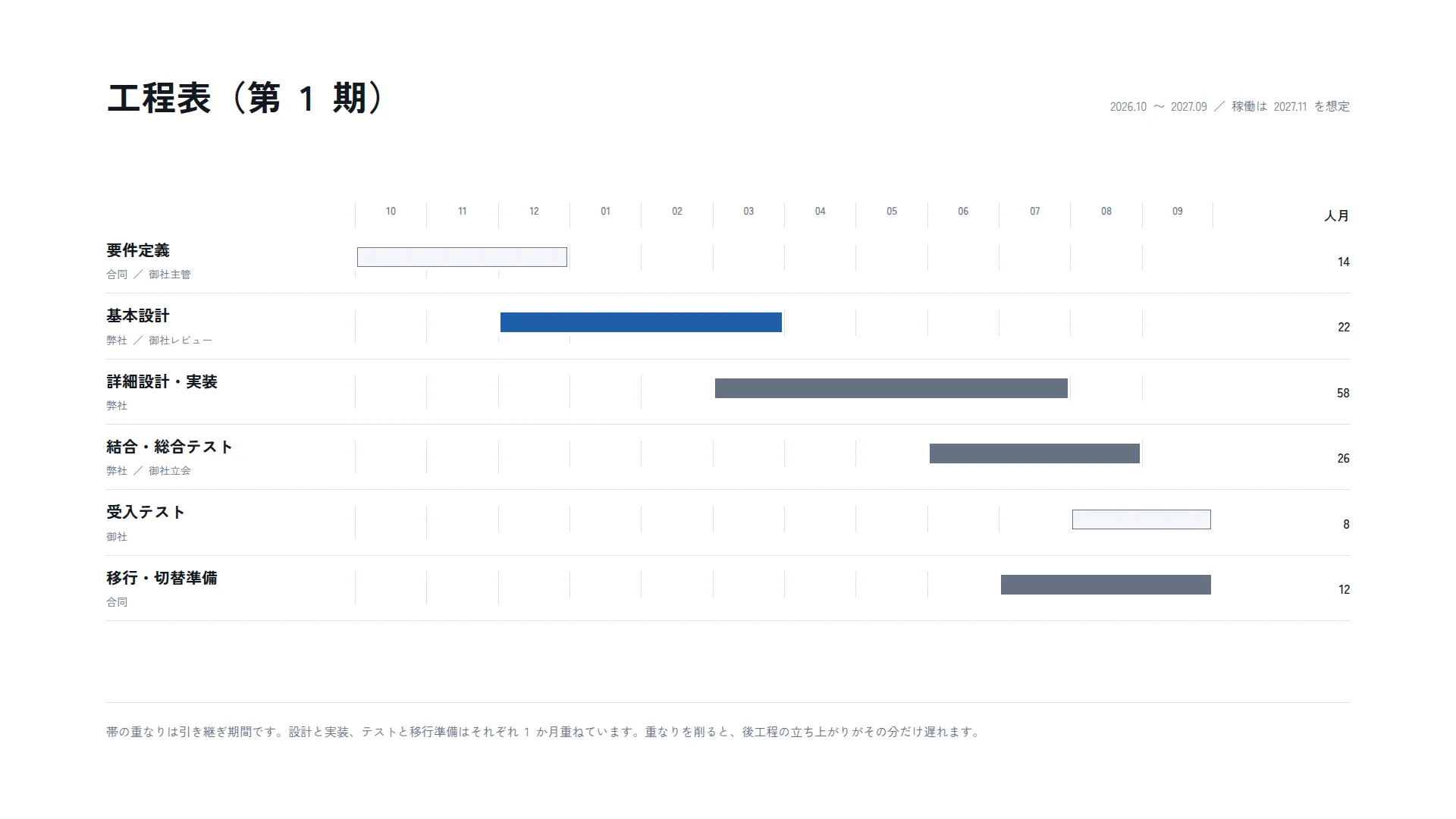
# Phase Schedule — Length Is Duration, Overlap Is Hand-off
Produce one slide to the following specification.

- Canvas 1920 × 1080
- Margin top 100 right 140 bottom 100 left 140

## Emphasis
row 2 only, by fill and nothing else

## Type (px against a 1920px canvas)
title  46px / 700 / tracking 0.01em / leading 1.3
basis  16px / 400 / tabular numerals
m  14px / 500 / tabular numerals
effort  17px / 500 / tabular numerals
pname  21px / 700 / leading 1.4
powner  14px / 400
foot  16px / 400 / leading 1.8

## Colour
Ground #FFFFFF / Surface #F4F6F9 / Ink #131820 / Muted #667183 / Accent #1F5FA8 / Rule #DBE1E9

## Constraints — dropping these breaks it
- Rule every month boundary — a gantt without a scale can only be read as "around March", which is not something anyone can agree to
- Keep the overlaps: they are the hand-off. Butted bars hide the time a later phase needs to start moving
- Outline the client's own work instead of filling it — one fill for both sides erases who is carrying what
- One accent bar, the current one. Add a second colour meaning and you lose the ability to say "now" in colour
- Put the effort figure at the far right; beside the bar it merges with duration, and a long bar reads as a heavy one

Replace the content with [your content]. Keep the measurements and colours as given.
For an exact reproduction, use the verbatim HTML at https://design-vault.pages.dev/designs/wbs-gantt-six-phases/pattern.html.

---

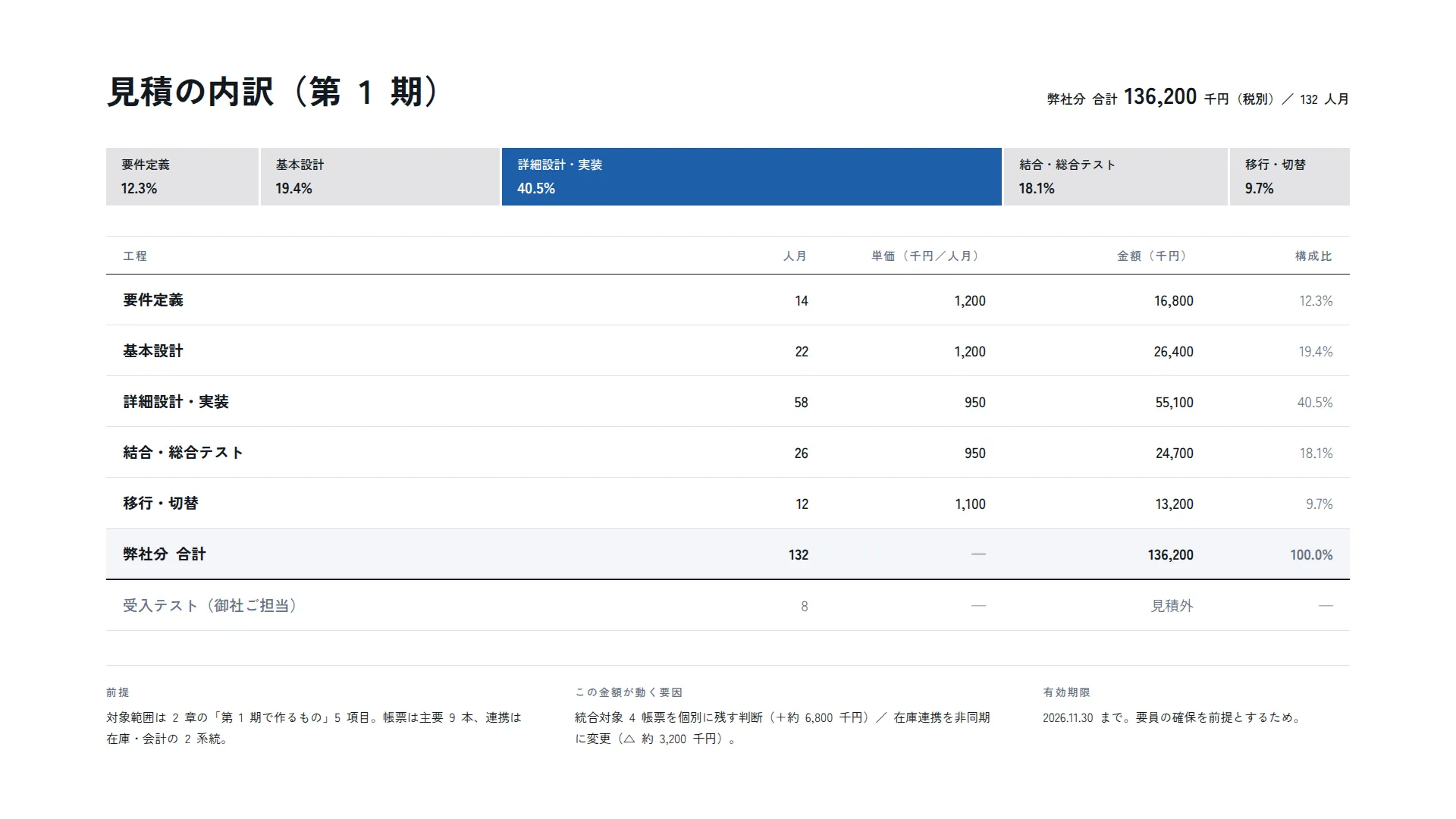
# Estimate Breakdown — Share of Cost Before the Total
Produce one slide to the following specification.

- Canvas 1920 × 1080
- Margin top 92 right 140 bottom 92 left 140
- 5 equal columns, gap 3

## Emphasis
column 3 only, by fill and nothing else

## Type (px against a 1920px canvas)
title  44px / 700 / tracking 0.01em / leading 1.3
total  17px / 500 / tabular numerals
segName  16px / 500
segPct  20px / 700 / tabular numerals
col  15px / 500 / tracking 0.12em
pname  20px / 700 / leading 1.4
num  19px / 500 / tabular numerals
fkey  14px / 500 / tracking 0.14em
fval  16px / 400 / leading 1.75 / tabular numerals

## Colour
Ground #FFFFFF / Surface #F4F6F9 / Ink #131820 / Muted #667183 / Accent #1F5FA8 / Rule #DBE1E9

## Constraints — dropping these breaks it
- Put the proportional bar above the table — read from the total first, the conversation is about the price, not about where the cost sits
- Give every phase its own rate: with a single blended rate, removing a phase does not recompute, and the negotiation turns into arithmetic
- Keep the client's own effort as a row with no amount — deleted, it reads as "nothing is asked of us"
- Assumptions and swing factors belong on this page; on an annex the total travels alone and is taken as fixed whatever the scope does
- State the expiry — the figure assumes people are held, and an estimate with no expiry is read as a commitment
- Fill one segment, the heaviest. Fill two and "heaviest" stops meaning anything

Replace the content with [your content]. Keep the measurements and colours as given.
For an exact reproduction, use the verbatim HTML at https://design-vault.pages.dev/designs/estimate-breakdown-by-phase/pattern.html.

---

# Test Plan — Each Phase Paired With What Accepts It
Produce one slide to the following specification.

- Canvas 1920 × 1080
- Margin top 100 right 140 bottom 100 left 140
- 2 equal columns, gap 56

## Emphasis
column 2 only, by fill and nothing else

## Type (px against a 1920px canvas)
title  46px / 700 / tracking 0.01em / leading 1.3
lede  19px / 400 / leading 1.8
label  16px / 500 / tracking 0.18em / uppercase
lv  16px / 700 / tabular numerals
sname  24px / 700 / leading 1.4
sdoc  15px / 400 / leading 1.7
fkey  14px / 500 / tracking 0.14em
fval  17px / 500 / leading 1.6 / tabular numerals

## Colour
Ground #FFFFFF / Surface #F4F6F9 / Ink #131820 / Muted #667183 / Accent #1F5FA8 / Rule #DBE1E9

## Constraints — dropping these breaks it
- Do not draw the V as a diagonal — the shape becomes the subject and the pairing of L2 with T2, which is the point, gets missed
- Equal row counts on both sides; fewer tests than phases means some deliverable has nothing to accept it
- Name who runs each test — "system test" alone does not say who attends and who judges
- Write the acceptance criteria when the left-hand phase is written; decided just before the test, they describe what was built
- Fill only the accepting side; fill both and the slide stops saying who decides

Replace the content with [your content]. Keep the measurements and colours as given.
For an exact reproduction, use the verbatim HTML at https://design-vault.pages.dev/designs/test-v-model-paired/pattern.html.

---

# Change Control — Business Days on Every Step, and Where a Refusal Goes
Produce one slide to the following specification.

- Canvas 1920 × 1080
- Margin top 92 right 140 bottom 92 left 140
- 5 equal columns, gap 34

## Emphasis
column 3 only, by fill + rule and nothing else

## Type (px against a 1920px canvas)
title  46px / 700 / tracking 0.01em / leading 1.3
lede  19px / 400 / leading 1.8
days  14px / 500 / tracking 0.14em / tabular numerals
sname  28px / 700 / leading 1.4
who  15px / 500
out  15px / 400 / leading 1.7
rname  20px / 700
rtext  16px / 400 / leading 1.75
fkey  14px / 500 / tracking 0.14em
fval  17px / 500 / leading 1.65 / tabular numerals

## Colour
Ground #FFFFFF / Surface #F4F6F9 / Ink #131820 / Muted #667183 / Accent #1F5FA8 / Rule #DBE1E9

## Constraints — dropping these breaks it
- Put business days on every step — a flow with no clock never answers "when", so the team starts building before the answer arrives
- Draw where a refusal goes; with nowhere to go, the same request comes back through intake next month
- Split the judge by size — send everything to one forum and a two-day change waits for a monthly meeting
- Make replanning its own step; when it is not a step, small changes accumulate without ever reaching the schedule
- Fill the one step that stops. The others are work; filling them hides where the waiting happens
- Drop the branch from the judging step's left edge — landing mid-rule makes the heading to its left look like the source

Replace the content with [your content]. Keep the measurements and colours as given.
For an exact reproduction, use the verbatim HTML at https://design-vault.pages.dev/designs/change-request-flow-gates/pattern.html.

---

# Status Report — No Traffic Lights, a Remedy Column Instead
Produce one slide to the following specification.

- Canvas 1920 × 1080
- Margin top 96 right 140 bottom 96 left 140

## Emphasis
row 3 only, by fill + weight and nothing else

## Type (px against a 1920px canvas)
title  44px / 700 / tracking 0.01em / leading 1.3
period  17px / 400 / tabular numerals
col  15px / 500 / tracking 0.12em
pname  21px / 700 / leading 1.4
pct  20px / 500 / tabular numerals
state  18px / 500
fix  16px / 400 / leading 1.7
fkey  14px / 500 / tracking 0.14em
fval  18px / 500 / leading 1.6 / tabular numerals

## Colour
Ground #FFFFFF / Surface #F4F6F9 / Ink #131820 / Muted #667183 / Accent #1F5FA8 / Rule #DBE1E9

## Constraints — dropping these breaks it
- No traffic lights — there are six roles and neither red nor amber among them. A word for the state is what survives into the minutes anyway
- Every late row carries its remedy; a delay with no remedy is an announcement, not a report
- Plan as a tick inside the track, actual as the fill — two stacked bars cannot be told apart without reading a legend
- Fill only the row that asks for a decision; filling the late ones too makes "please decide" and "for your information" weigh the same
- Make the track a faint mix of ink, not the surface colour — on a filled row the two would match and the bar would lose its scale

Replace the content with [your content]. Keep the measurements and colours as given.
For an exact reproduction, use the verbatim HTML at https://design-vault.pages.dev/designs/status-report-rag-rows/pattern.html.

---

# Defect Status — Read the Blocking Cell, Not the Total
Produce one slide to the following specification.

- Canvas 1920 × 1080
- Margin top 92 right 140 bottom 92 left 140

## Emphasis
row 1 only, by fill + weight and nothing else

## Type (px against a 1920px canvas)
title  44px / 700 / tracking 0.01em / leading 1.3
period  17px / 400 / tabular numerals
col  15px / 500 / tracking 0.12em
sev  27px / 700 / leading 1.4
sevNote  14px / 400
n  42px / 700 / tabular numerals
nSoft  31px / 400 / tabular numerals
fkey  14px / 500 / tracking 0.14em
wn  18px / 700 / tabular numerals
wk  13px / 400 / tabular numerals
rule  16px / 400 / leading 1.8

## Colour
Ground #FFFFFF / Surface #F4F6F9 / Ink #131820 / Muted #667183 / Accent #1F5FA8 / Rule #DBE1E9

## Constraints — dropping these breaks it
- Never headline the total: "37 open" decides nothing. What decides is the unresolved cell at the top severity
- Define each severity in one line beside it — undefined, high and medium drift between reports
- Rule between the unresolved columns and done; merely adjacent, a large done count makes the unresolved look small
- Keep the done column — without the denominator there is no telling convergence from a test that has barely started
- Trend the open count alone; overlay found and fixed and the room debates the breakdown before answering whether it is converging
- State the gate on this page — kept elsewhere, the table reports a situation rather than supporting a decision

Replace the content with [your content]. Keep the measurements and colours as given.
For an exact reproduction, use the verbatim HTML at https://design-vault.pages.dev/designs/defect-severity-status-matrix/pattern.html.

---

# Cutover Runbook — The Rollback Call Has a Clock Time
Produce one slide to the following specification.

- Canvas 1920 × 1080
- Margin top 96 right 140 bottom 96 left 140

## Emphasis
row 5 only, by fill + rule and nothing else

## Type (px against a 1920px canvas)
title  44px / 700 / tracking 0.01em / leading 1.3
window  17px / 500 / tabular numerals
time  24px / 700 / tabular numerals
task  22px / 500 / leading 1.5
owner  16px / 400
note  16px / 400 / leading 1.7
fkey  14px / 500 / tracking 0.14em
fval  18px / 500 / leading 1.6 / tabular numerals

## Colour
Ground #111722 / Surface #1A2231 / Ink #E9EDF4 / Muted #8894A6 / Accent #5AA2E8 / Rule #2B3445

## Constraints — dropping these breaks it
- Give the rollback call a clock time and a row of its own in the sequence — a rollback policy kept on a separate page is not opened on the night
- Name the team, not the person, on every row — plan for the night when the person you had in mind cannot be reached
- Put durations in the note instead of making the reader subtract clock times at three in the morning
- State the outage window beside the title — what gets agreed is how long business stops, not the sum of the steps
- Always show the fallback date; without one, the rollback decision itself gets postponed

Replace the content with [your content]. Keep the measurements and colours as given.
For an exact reproduction, use the verbatim HTML at https://design-vault.pages.dev/designs/cutover-runbook-timeline/pattern.html.

---

# Closing Slide — Three Decisions, Each With a Date
Produce one slide to the following specification.

- Canvas 1920 × 1080
- Margin top 120 right 140 bottom 120 left 140

## Type (px against a 1920px canvas)
kicker  15px / 500 / tracking 0.3em / uppercase
title  54px / 700 / tracking 0.01em / leading 1.35
lede  19px / 400 / leading 1.9
n  30px / 700 / tabular numerals
what  27px / 700 / leading 1.45
why  16px / 400 / leading 1.7
due  20px / 500 / tabular numerals
dueNote  14px / 400
next  18px / 500 / leading 1.7 / tabular numerals

## Colour
Ground #FFFFFF / Surface #F4F6F9 / Ink #131820 / Muted #667183 / Accent #1F5FA8 / Rule #DBE1E9

## Constraints — dropping these breaks it
- Three asks at most — add a fourth and all of them go home to be considered
- Every date carries what slips if it is missed; a bare date does not tell the reader whether it is a real one
- Cite the chapter for each ask, so someone reading only this page can find the argument without paging back and forth
- Put the next meeting at the foot — a closing page with no next date leaves the deadlines with nothing to land on
- Centre it: this page is a signal rather than a reading. Left-aligned, it reads as one more content slide and gets skimmed

Replace the content with [your content]. Keep the measurements and colours as given.
For an exact reproduction, use the verbatim HTML at https://design-vault.pages.dev/designs/closing-decision-request/pattern.html.

---

# Appendix Door — What Is Inside, as a Numbered Grid
Produce one slide to the following specification.

- Canvas 1920 × 1080
- Margin top 108 right 140 bottom 108 left 140
- 3 equal columns, gap 24

## Type (px against a 1920px canvas)
kicker  15px / 500 / tracking 0.3em / uppercase
title  54px / 700 / tracking 0.01em / leading 1.3
count  17px / 400 / tabular numerals
id  16px / 700 / tracking 0.14em / tabular numerals
name  25px / 700 / leading 1.4
about  16px / 400 / leading 1.7
pages  14px / 400 / tabular numerals
foot  16px / 400 / leading 1.8

## Colour
Ground #111722 / Surface #1A2231 / Ink #E9EDF4 / Muted #8894A6 / Accent #5AA2E8 / Rule #2B3445

## Constraints — dropping these breaks it
- Tile it. A vertical list makes the appendix look like more reading, and people enter it the way they left the main deck
- One line of contents and a page count per item — a list of titles alone makes people open every one
- Raise the rule only on the items you will actually open; raised everywhere it stops being an index
- Number the appendices on their own series, apart from the chapters — shared numbers send every question to the wrong page
- Say plainly that this is outside the main deck — the appendix door is also the signal that nothing after it gets read aloud

Replace the content with [your content]. Keep the measurements and colours as given.
For an exact reproduction, use the verbatim HTML at https://design-vault.pages.dev/designs/appendix-index-grid/pattern.html.
# Project Deck Cover — Subject Above the Issue Record
format: slide-16x9
density: low
layout:
  kind: stack
  canvas:
    w: 1920
    h: 1080
  margin:
    top: 116
    right: 140
    bottom: 116
    left: 140
type:
  doctype:
    size: 20
    weight: 700
    tracking: 0.08em
  edition:
    size: 17
    weight: 400
    tracking: 0.04em
    numeric: tabular
  kicker:
    size: 15
    weight: 500
    tracking: 0.3em
    transform: upper
  title:
    size: 84
    weight: 700
    tracking: 0.01em
    leading: 1.28
  lede:
    size: 20
    weight: 400
    leading: 1.9
  label:
    size: 14
    weight: 500
    tracking: 0.14em
  value:
    size: 21
    weight: 500
    numeric: tabular
colors:
  ground: "#111722"
  surface: "#1A2231"
  ink: "#E9EDF4"
  muted: "#8894A6"
  accent: "#5AA2E8"
  rule: "#2B3445"
rules:
  - Keep the four issue fields — a project deck goes out many times under the same subject, and without version, date and recipient no one can tell which copy they hold
  - "The document type is the one thing allowed to be read before the subject: a small filled box, separated from the subject by size rather than position"
  - Colour only the second line of the subject — the first names the project, the second names what this deck covers
  - Never pure white on a dark ground — the cover stays on screen longer than any other slide

---

# Agenda — Each Section Carries What It Asks For
format: slide-16x9
density: medium
layout:
  kind: 2-column
  canvas:
    w: 1920
    h: 1080
  margin:
    top: 112
    right: 140
    bottom: 112
    left: 140
  columns:
    count: 2
    gap: 104
type:
  kicker:
    size: 15
    weight: 500
    tracking: 0.28em
    transform: upper
  title:
    size: 56
    weight: 700
    tracking: 0.01em
    leading: 1.3
  mkey:
    size: 15
    weight: 500
    tracking: 0.12em
  mval:
    size: 17
    weight: 500
    leading: 1.65
    numeric: tabular
  note:
    size: 17
    weight: 400
    leading: 1.9
  num:
    size: 30
    weight: 700
    numeric: tabular
  name:
    size: 30
    weight: 500
    leading: 1.45
  goal:
    size: 16
    weight: 400
    leading: 1.7
colors:
  ground: "#FFFFFF"
  surface: "#F4F6F9"
  ink: "#131820"
  muted: "#667183"
  accent: "#1F5FA8"
  rule: "#DBE1E9"
rules:
  - Put the decision each section seeks beside its name — an agenda without it is a timetable, and the room cannot tell how to listen
  - Dim the sections you will not cover rather than removing them — removed reads as absent, and sends people hunting in the appendix
  - Keep the session facts on the same page as the sections; on a separate slide nobody remembers when the meeting ends
  - Two-digit numbers throughout — mixing one and two digits breaks the left edge the list is read down

---

# Scope Boundary — In and Out at the Same Size
format: slide-16x9
density: medium
layout:
  kind: 2-column
  canvas:
    w: 1920
    h: 1080
  margin:
    top: 108
    right: 140
    bottom: 108
    left: 140
  columns:
    count: 2
    gap: 64
  emphasis:
    column: 1
    via:
      - rule
type:
  title:
    size: 48
    weight: 700
    tracking: 0.01em
    leading: 1.3
  lede:
    size: 19
    weight: 400
    leading: 1.8
  side:
    size: 16
    weight: 500
    tracking: 0.18em
    transform: upper
  heading:
    size: 34
    weight: 700
    leading: 1.35
  item:
    size: 20
    weight: 500
    leading: 1.5
  why:
    size: 16
    weight: 400
    leading: 1.75
  foot:
    size: 17
    weight: 500
colors:
  ground: "#FFFFFF"
  surface: "#F4F6F9"
  ink: "#131820"
  muted: "#667183"
  accent: "#1F5FA8"
  rule: "#DBE1E9"
rules:
  - Keep the two fields equal — a smaller out-of-scope reads as unimportant and comes back later as "we assumed it was included"
  - Match the counts too; three items against seven looks like one side was not thought about
  - Give every out-of-scope item a when — without a date it reads as a refusal, not a sequence
  - Emphasis is the rule colour alone — fill both fields and the boundary, which is the whole point, disappears

---

# Phase Divider — The Whole Process, With a Mark on Now
format: slide-16x9
density: low
layout:
  kind: timeline
  canvas:
    w: 1920
    h: 1080
  margin:
    top: 124
    right: 140
    bottom: 124
    left: 140
  columns:
    count: 7
    gap: 24
  emphasis:
    column: 4
    via:
      - rule
      - weight
type:
  chapter:
    size: 15
    weight: 500
    tracking: 0.3em
    transform: upper
  of:
    size: 15
    weight: 400
    tracking: 0.12em
    numeric: tabular
  num:
    size: 136
    weight: 700
    leading: 1
    numeric: tabular
  title:
    size: 68
    weight: 700
    tracking: 0.01em
    leading: 1.3
  lede:
    size: 20
    weight: 400
    leading: 1.9
  phase:
    size: 18
    weight: 500
  when:
    size: 14
    weight: 400
    numeric: tabular
colors:
  ground: "#111722"
  ink: "#E9EDF4"
  muted: "#8894A6"
  accent: "#5AA2E8"
  rule: "#2B3445"
rules:
  - Keep the phases equal in width — encoding duration as width reads as slippage
  - Mark the current phase with the rule and the weight, no fill — a filled band makes this read as a schedule rather than a divider
  - Do not dim the finished phases; an unbroken row is what says the whole process is still in view
  - The section number and the phase rail are different axes — never renumber one to match the other

---

# System Architecture — Three Tiers, One of Them New
format: slide-16x9
density: high
layout:
  kind: stack
  canvas:
    w: 1920
    h: 1080
  margin:
    top: 104
    right: 140
    bottom: 104
    left: 140
  emphasis:
    row: 2
    via:
      - fill
      - rule
type:
  title:
    size: 46
    weight: 700
    tracking: 0.01em
    leading: 1.3
  lede:
    size: 19
    weight: 400
    leading: 1.8
  tname:
    size: 24
    weight: 700
    leading: 1.4
  tnote:
    size: 15
    weight: 400
    leading: 1.6
  bname:
    size: 19
    weight: 500
    leading: 1.4
  btag:
    size: 14
    weight: 400
  fkey:
    size: 14
    weight: 500
    tracking: 0.14em
  fval:
    size: 17
    weight: 500
    leading: 1.6
colors:
  ground: "#FFFFFF"
  surface: "#F4F6F9"
  ink: "#131820"
  muted: "#667183"
  accent: "#1F5FA8"
  rule: "#DBE1E9"
rules:
  - Three tiers at most — a fourth makes the room memorise names instead of hearing which part you are building
  - Fill only the tier that is new throughout; mark additions elsewhere on the boxes. Filling every tier reads as a full rebuild, and the cost conversation starts there
  - Never dash the existing systems — a dashed box reads as undecided. Dim the label instead; these are the settled parts
  - Five boxes per tier. From the sixth on, what the room remembers is the count, not the names
  - State the integration style in one line at the foot; drawn as arrows it costs more time to explain than it saves

---

# Requirement Responses — Only the Alternative Is Filled
format: slide-16x9
density: high
layout:
  kind: table
  canvas:
    w: 1920
    h: 1080
  margin:
    top: 104
    right: 140
    bottom: 104
    left: 140
  emphasis:
    row: 3
    via:
      - fill
      - weight
type:
  title:
    size: 44
    weight: 700
    tracking: 0.01em
    leading: 1.3
  count:
    size: 17
    weight: 400
    numeric: tabular
  col:
    size: 15
    weight: 500
    tracking: 0.12em
  rid:
    size: 19
    weight: 500
    numeric: tabular
  req:
    size: 21
    weight: 500
    leading: 1.5
  verdict:
    size: 17
    weight: 500
  how:
    size: 17
    weight: 400
    leading: 1.7
  when:
    size: 17
    weight: 400
  foot:
    size: 16
    weight: 400
    leading: 1.8
colors:
  ground: "#FFFFFF"
  surface: "#F4F6F9"
  ink: "#131820"
  muted: "#667183"
  accent: "#1F5FA8"
  rule: "#DBE1E9"
rules:
  - Three verdicts only — met, alternative, next phase. "Met with conditions" gets agreed to without the conditions ever being read
  - Fill only the alternative row; filling the met rows makes the whole table emphasis and buries the one row worth discussing
  - Keep the means in the same row — sent to an annex, "alternative" travels alone and nobody can say what changed
  - If it is an extract, say so beside the title — six of forty-eight is a different slide from six of six
  - Carry the client's own requirement IDs unchanged; renumbering costs a lookup in every later exchange

---

# Team Structure — One Place to Decide, One Joint Desk
format: slide-16x9
density: medium
layout:
  kind: tree
  canvas:
    w: 1920
    h: 1080
  margin:
    top: 100
    right: 140
    bottom: 100
    left: 140
  emphasis:
    row: 2
    via:
      - fill
      - rule
type:
  title:
    size: 46
    weight: 700
    tracking: 0.01em
    leading: 1.3
  lede:
    size: 19
    weight: 400
    leading: 1.8
  role:
    size: 15
    weight: 500
    tracking: 0.12em
  who:
    size: 26
    weight: 700
    leading: 1.35
  cadence:
    size: 15
    weight: 400
    numeric: tabular
  tname:
    size: 22
    weight: 700
    leading: 1.4
  tside:
    size: 14
    weight: 500
    tracking: 0.12em
  heads:
    size: 15
    weight: 400
    leading: 1.8
    numeric: tabular
  foot:
    size: 16
    weight: 400
    leading: 1.8
colors:
  ground: "#FFFFFF"
  surface: "#F4F6F9"
  ink: "#131820"
  muted: "#667183"
  accent: "#1F5FA8"
  rule: "#DBE1E9"
rules:
  - Name forums, not people — an org chart made of names goes stale the first time someone rotates off
  - Fill exactly one desk. Two filled desks means there is no desk
  - "Give each node its cadence: a monthly decision and a twice-weekly consultation are different organs"
  - Stop the connector at the outermost team's centre — run it to the margin and the chart implies more teams off-page
  - Say who leads each team. A box with no lead is the one nobody claims when it matters

---

# Phase Schedule — Length Is Duration, Overlap Is Hand-off
format: slide-16x9
density: high
layout:
  kind: gantt
  canvas:
    w: 1920
    h: 1080
  margin:
    top: 100
    right: 140
    bottom: 100
    left: 140
  emphasis:
    row: 2
    via:
      - fill
type:
  title:
    size: 46
    weight: 700
    tracking: 0.01em
    leading: 1.3
  basis:
    size: 16
    weight: 400
    numeric: tabular
  m:
    size: 14
    weight: 500
    numeric: tabular
  effort:
    size: 17
    weight: 500
    numeric: tabular
  pname:
    size: 21
    weight: 700
    leading: 1.4
  powner:
    size: 14
    weight: 400
  foot:
    size: 16
    weight: 400
    leading: 1.8
colors:
  ground: "#FFFFFF"
  surface: "#F4F6F9"
  ink: "#131820"
  muted: "#667183"
  accent: "#1F5FA8"
  rule: "#DBE1E9"
rules:
  - Rule every month boundary — a gantt without a scale can only be read as "around March", which is not something anyone can agree to
  - "Keep the overlaps: they are the hand-off. Butted bars hide the time a later phase needs to start moving"
  - Outline the client's own work instead of filling it — one fill for both sides erases who is carrying what
  - One accent bar, the current one. Add a second colour meaning and you lose the ability to say "now" in colour
  - Put the effort figure at the far right; beside the bar it merges with duration, and a long bar reads as a heavy one

---

# Estimate Breakdown — Share of Cost Before the Total
format: slide-16x9
density: high
layout:
  kind: waterfall
  canvas:
    w: 1920
    h: 1080
  margin:
    top: 92
    right: 140
    bottom: 92
    left: 140
  columns:
    count: 5
    gap: 3
  emphasis:
    column: 3
    via:
      - fill
type:
  title:
    size: 44
    weight: 700
    tracking: 0.01em
    leading: 1.3
  total:
    size: 17
    weight: 500
    numeric: tabular
  segName:
    size: 16
    weight: 500
  segPct:
    size: 20
    weight: 700
    numeric: tabular
  col:
    size: 15
    weight: 500
    tracking: 0.12em
  pname:
    size: 20
    weight: 700
    leading: 1.4
  num:
    size: 19
    weight: 500
    numeric: tabular
  fkey:
    size: 14
    weight: 500
    tracking: 0.14em
  fval:
    size: 16
    weight: 400
    leading: 1.75
    numeric: tabular
colors:
  ground: "#FFFFFF"
  surface: "#F4F6F9"
  ink: "#131820"
  muted: "#667183"
  accent: "#1F5FA8"
  rule: "#DBE1E9"
rules:
  - Put the proportional bar above the table — read from the total first, the conversation is about the price, not about where the cost sits
  - "Give every phase its own rate: with a single blended rate, removing a phase does not recompute, and the negotiation turns into arithmetic"
  - Keep the client's own effort as a row with no amount — deleted, it reads as "nothing is asked of us"
  - Assumptions and swing factors belong on this page; on an annex the total travels alone and is taken as fixed whatever the scope does
  - State the expiry — the figure assumes people are held, and an estimate with no expiry is read as a commitment
  - Fill one segment, the heaviest. Fill two and "heaviest" stops meaning anything

---

# Test Plan — Each Phase Paired With What Accepts It
format: slide-16x9
density: medium
layout:
  kind: 2-column
  canvas:
    w: 1920
    h: 1080
  margin:
    top: 100
    right: 140
    bottom: 100
    left: 140
  columns:
    count: 2
    gap: 56
  emphasis:
    column: 2
    via:
      - fill
type:
  title:
    size: 46
    weight: 700
    tracking: 0.01em
    leading: 1.3
  lede:
    size: 19
    weight: 400
    leading: 1.8
  label:
    size: 16
    weight: 500
    tracking: 0.18em
    transform: upper
  lv:
    size: 16
    weight: 700
    numeric: tabular
  sname:
    size: 24
    weight: 700
    leading: 1.4
  sdoc:
    size: 15
    weight: 400
    leading: 1.7
  fkey:
    size: 14
    weight: 500
    tracking: 0.14em
  fval:
    size: 17
    weight: 500
    leading: 1.6
    numeric: tabular
colors:
  ground: "#FFFFFF"
  surface: "#F4F6F9"
  ink: "#131820"
  muted: "#667183"
  accent: "#1F5FA8"
  rule: "#DBE1E9"
rules:
  - Do not draw the V as a diagonal — the shape becomes the subject and the pairing of L2 with T2, which is the point, gets missed
  - Equal row counts on both sides; fewer tests than phases means some deliverable has nothing to accept it
  - Name who runs each test — "system test" alone does not say who attends and who judges
  - Write the acceptance criteria when the left-hand phase is written; decided just before the test, they describe what was built
  - Fill only the accepting side; fill both and the slide stops saying who decides

---

# Change Control — Business Days on Every Step, and Where a Refusal Goes
format: slide-16x9
density: medium
layout:
  kind: flow
  canvas:
    w: 1920
    h: 1080
  margin:
    top: 92
    right: 140
    bottom: 92
    left: 140
  columns:
    count: 5
    gap: 34
  emphasis:
    column: 3
    via:
      - fill
      - rule
type:
  title:
    size: 46
    weight: 700
    tracking: 0.01em
    leading: 1.3
  lede:
    size: 19
    weight: 400
    leading: 1.8
  days:
    size: 14
    weight: 500
    tracking: 0.14em
    numeric: tabular
  sname:
    size: 28
    weight: 700
    leading: 1.4
  who:
    size: 15
    weight: 500
  out:
    size: 15
    weight: 400
    leading: 1.7
  rname:
    size: 20
    weight: 700
  rtext:
    size: 16
    weight: 400
    leading: 1.75
  fkey:
    size: 14
    weight: 500
    tracking: 0.14em
  fval:
    size: 17
    weight: 500
    leading: 1.65
    numeric: tabular
colors:
  ground: "#FFFFFF"
  surface: "#F4F6F9"
  ink: "#131820"
  muted: "#667183"
  accent: "#1F5FA8"
  rule: "#DBE1E9"
rules:
  - Put business days on every step — a flow with no clock never answers "when", so the team starts building before the answer arrives
  - Draw where a refusal goes; with nowhere to go, the same request comes back through intake next month
  - Split the judge by size — send everything to one forum and a two-day change waits for a monthly meeting
  - Make replanning its own step; when it is not a step, small changes accumulate without ever reaching the schedule
  - Fill the one step that stops. The others are work; filling them hides where the waiting happens
  - Drop the branch from the judging step's left edge — landing mid-rule makes the heading to its left look like the source

---

# Status Report — No Traffic Lights, a Remedy Column Instead
format: slide-16x9
density: high
layout:
  kind: table
  canvas:
    w: 1920
    h: 1080
  margin:
    top: 96
    right: 140
    bottom: 96
    left: 140
  emphasis:
    row: 3
    via:
      - fill
      - weight
type:
  title:
    size: 44
    weight: 700
    tracking: 0.01em
    leading: 1.3
  period:
    size: 17
    weight: 400
    numeric: tabular
  col:
    size: 15
    weight: 500
    tracking: 0.12em
  pname:
    size: 21
    weight: 700
    leading: 1.4
  pct:
    size: 20
    weight: 500
    numeric: tabular
  state:
    size: 18
    weight: 500
  fix:
    size: 16
    weight: 400
    leading: 1.7
  fkey:
    size: 14
    weight: 500
    tracking: 0.14em
  fval:
    size: 18
    weight: 500
    leading: 1.6
    numeric: tabular
colors:
  ground: "#FFFFFF"
  surface: "#F4F6F9"
  ink: "#131820"
  muted: "#667183"
  accent: "#1F5FA8"
  rule: "#DBE1E9"
rules:
  - No traffic lights — there are six roles and neither red nor amber among them. A word for the state is what survives into the minutes anyway
  - Every late row carries its remedy; a delay with no remedy is an announcement, not a report
  - Plan as a tick inside the track, actual as the fill — two stacked bars cannot be told apart without reading a legend
  - Fill only the row that asks for a decision; filling the late ones too makes "please decide" and "for your information" weigh the same
  - Make the track a faint mix of ink, not the surface colour — on a filled row the two would match and the bar would lose its scale

---

# Defect Status — Read the Blocking Cell, Not the Total
format: slide-16x9
density: high
layout:
  kind: matrix
  canvas:
    w: 1920
    h: 1080
  margin:
    top: 92
    right: 140
    bottom: 92
    left: 140
  emphasis:
    row: 1
    via:
      - fill
      - weight
type:
  title:
    size: 44
    weight: 700
    tracking: 0.01em
    leading: 1.3
  period:
    size: 17
    weight: 400
    numeric: tabular
  col:
    size: 15
    weight: 500
    tracking: 0.12em
  sev:
    size: 27
    weight: 700
    leading: 1.4
  sevNote:
    size: 14
    weight: 400
  n:
    size: 42
    weight: 700
    numeric: tabular
  nSoft:
    size: 31
    weight: 400
    numeric: tabular
  fkey:
    size: 14
    weight: 500
    tracking: 0.14em
  wn:
    size: 18
    weight: 700
    numeric: tabular
  wk:
    size: 13
    weight: 400
    numeric: tabular
  rule:
    size: 16
    weight: 400
    leading: 1.8
colors:
  ground: "#FFFFFF"
  surface: "#F4F6F9"
  ink: "#131820"
  muted: "#667183"
  accent: "#1F5FA8"
  rule: "#DBE1E9"
rules:
  - 'Never headline the total: "37 open" decides nothing. What decides is the unresolved cell at the top severity'
  - Define each severity in one line beside it — undefined, high and medium drift between reports
  - Rule between the unresolved columns and done; merely adjacent, a large done count makes the unresolved look small
  - Keep the done column — without the denominator there is no telling convergence from a test that has barely started
  - Trend the open count alone; overlay found and fixed and the room debates the breakdown before answering whether it is converging
  - State the gate on this page — kept elsewhere, the table reports a situation rather than supporting a decision

---

# Cutover Runbook — The Rollback Call Has a Clock Time
format: slide-16x9
density: high
layout:
  kind: timeline
  canvas:
    w: 1920
    h: 1080
  margin:
    top: 96
    right: 140
    bottom: 96
    left: 140
  emphasis:
    row: 5
    via:
      - fill
      - rule
type:
  title:
    size: 44
    weight: 700
    tracking: 0.01em
    leading: 1.3
  window:
    size: 17
    weight: 500
    numeric: tabular
  time:
    size: 24
    weight: 700
    numeric: tabular
  task:
    size: 22
    weight: 500
    leading: 1.5
  owner:
    size: 16
    weight: 400
  note:
    size: 16
    weight: 400
    leading: 1.7
  fkey:
    size: 14
    weight: 500
    tracking: 0.14em
  fval:
    size: 18
    weight: 500
    leading: 1.6
    numeric: tabular
colors:
  ground: "#111722"
  surface: "#1A2231"
  ink: "#E9EDF4"
  muted: "#8894A6"
  accent: "#5AA2E8"
  rule: "#2B3445"
rules:
  - Give the rollback call a clock time and a row of its own in the sequence — a rollback policy kept on a separate page is not opened on the night
  - Name the team, not the person, on every row — plan for the night when the person you had in mind cannot be reached
  - Put durations in the note instead of making the reader subtract clock times at three in the morning
  - State the outage window beside the title — what gets agreed is how long business stops, not the sum of the steps
  - Always show the fallback date; without one, the rollback decision itself gets postponed

---

# Closing Slide — Three Decisions, Each With a Date
format: slide-16x9
density: low
layout:
  kind: centered
  canvas:
    w: 1920
    h: 1080
  margin:
    top: 120
    right: 140
    bottom: 120
    left: 140
type:
  kicker:
    size: 15
    weight: 500
    tracking: 0.3em
    transform: upper
  title:
    size: 54
    weight: 700
    tracking: 0.01em
    leading: 1.35
  lede:
    size: 19
    weight: 400
    leading: 1.9
  n:
    size: 30
    weight: 700
    numeric: tabular
  what:
    size: 27
    weight: 700
    leading: 1.45
  why:
    size: 16
    weight: 400
    leading: 1.7
  due:
    size: 20
    weight: 500
    numeric: tabular
  dueNote:
    size: 14
    weight: 400
  next:
    size: 18
    weight: 500
    leading: 1.7
    numeric: tabular
colors:
  ground: "#FFFFFF"
  surface: "#F4F6F9"
  ink: "#131820"
  muted: "#667183"
  accent: "#1F5FA8"
  rule: "#DBE1E9"
rules:
  - Three asks at most — add a fourth and all of them go home to be considered
  - Every date carries what slips if it is missed; a bare date does not tell the reader whether it is a real one
  - Cite the chapter for each ask, so someone reading only this page can find the argument without paging back and forth
  - Put the next meeting at the foot — a closing page with no next date leaves the deadlines with nothing to land on
  - "Centre it: this page is a signal rather than a reading. Left-aligned, it reads as one more content slide and gets skimmed"

---

# Appendix Door — What Is Inside, as a Numbered Grid
format: slide-16x9
density: medium
layout:
  kind: grid
  canvas:
    w: 1920
    h: 1080
  margin:
    top: 108
    right: 140
    bottom: 108
    left: 140
  columns:
    count: 3
    gap: 24
type:
  kicker:
    size: 15
    weight: 500
    tracking: 0.3em
    transform: upper
  title:
    size: 54
    weight: 700
    tracking: 0.01em
    leading: 1.3
  count:
    size: 17
    weight: 400
    numeric: tabular
  id:
    size: 16
    weight: 700
    tracking: 0.14em
    numeric: tabular
  name:
    size: 25
    weight: 700
    leading: 1.4
  about:
    size: 16
    weight: 400
    leading: 1.7
  pages:
    size: 14
    weight: 400
    numeric: tabular
  foot:
    size: 16
    weight: 400
    leading: 1.8
colors:
  ground: "#111722"
  surface: "#1A2231"
  ink: "#E9EDF4"
  muted: "#8894A6"
  accent: "#5AA2E8"
  rule: "#2B3445"
rules:
  - Tile it. A vertical list makes the appendix look like more reading, and people enter it the way they left the main deck
  - One line of contents and a page count per item — a list of titles alone makes people open every one
  - Raise the rule only on the items you will actually open; raised everywhere it stops being an index
  - Number the appendices on their own series, apart from the chapters — shared numbers send every question to the wrong page
- Say plainly that this is outside the main deck — the appendix door is also the signal that nothing after it gets read aloud  Project Deck Cover — Subject Above the Issue Record
  Agenda — Each Section Carries What It Asks For
  Scope Boundary — In and Out at the Same Size
  Phase Divider — The Whole Process, With a Mark on Now
  System Architecture — Three Tiers, One of Them New
  Requirement Responses — Only the Alternative Is Filled
  Team Structure — One Place to Decide, One Joint Desk
  Phase Schedule — Length Is Duration, Overlap Is Hand-off
  Estimate Breakdown — Share of Cost Before the Total
  Test Plan — Each Phase Paired With What Accepts It
  Change Control — Business Days on Every Step, and Where a Refusal Goes
  Status Report — No Traffic Lights, a Remedy Column Instead
  Defect Status — Read the Blocking Cell, Not the Total
  Cutover Runbook — The Rollback Call Has a Clock Time
  Closing Slide — Three Decisions, Each With a Date
  Appendix Door — What Is Inside, as a Numbered Grid