# Speaker Profile — A Portrait Frame and Only the Career That Earns the Talk
Produce one slide to the following specification.

- Canvas 1920 × 1080
- Margin top 96 right 140 bottom 96 left 140
- 2 equal columns, gap 96

## Type (px against a 1920px canvas)
kicker  20px / 500 / tracking 0.16em
name  64px / 700 / tracking 0.06em / leading 1.2
reading  22px / 400 / tracking 0.12em
role  26px / 500 / leading 1.6
year  22px / 500 / tabular numerals
what  24px / 400 / leading 1.6
todayLabel  20px / 700
todayText  22px / 400 / leading 1.7
folio  16px / 400 / tabular numerals

## Colour
Ground #FFFFFF / Surface #F4F6F9 / Ink #131820 / Muted #667183 / Accent #1F5FA8 / Rule #DBE1E9

## Constraints — dropping these breaks it
- Three career lines at most, chosen for today's talk — turn it into a CV and the audience reads a life instead of a reason to listen
- The portrait frame is 4:5 with the eyes on the upper third. Until a photo exists, shapes show the ratio and crop — never a drawn person
- Put the reading under the name, so nobody mispronounces it for the whole talk
- End with one line on today's topic, so the introduction hands over to the talk

Replace the content with [your content]. Keep the measurements and colours as given.
For an exact reproduction, use the verbatim HTML at https://design-vault.pages.dev/designs/speaker-profile-portrait/pattern.html.

---

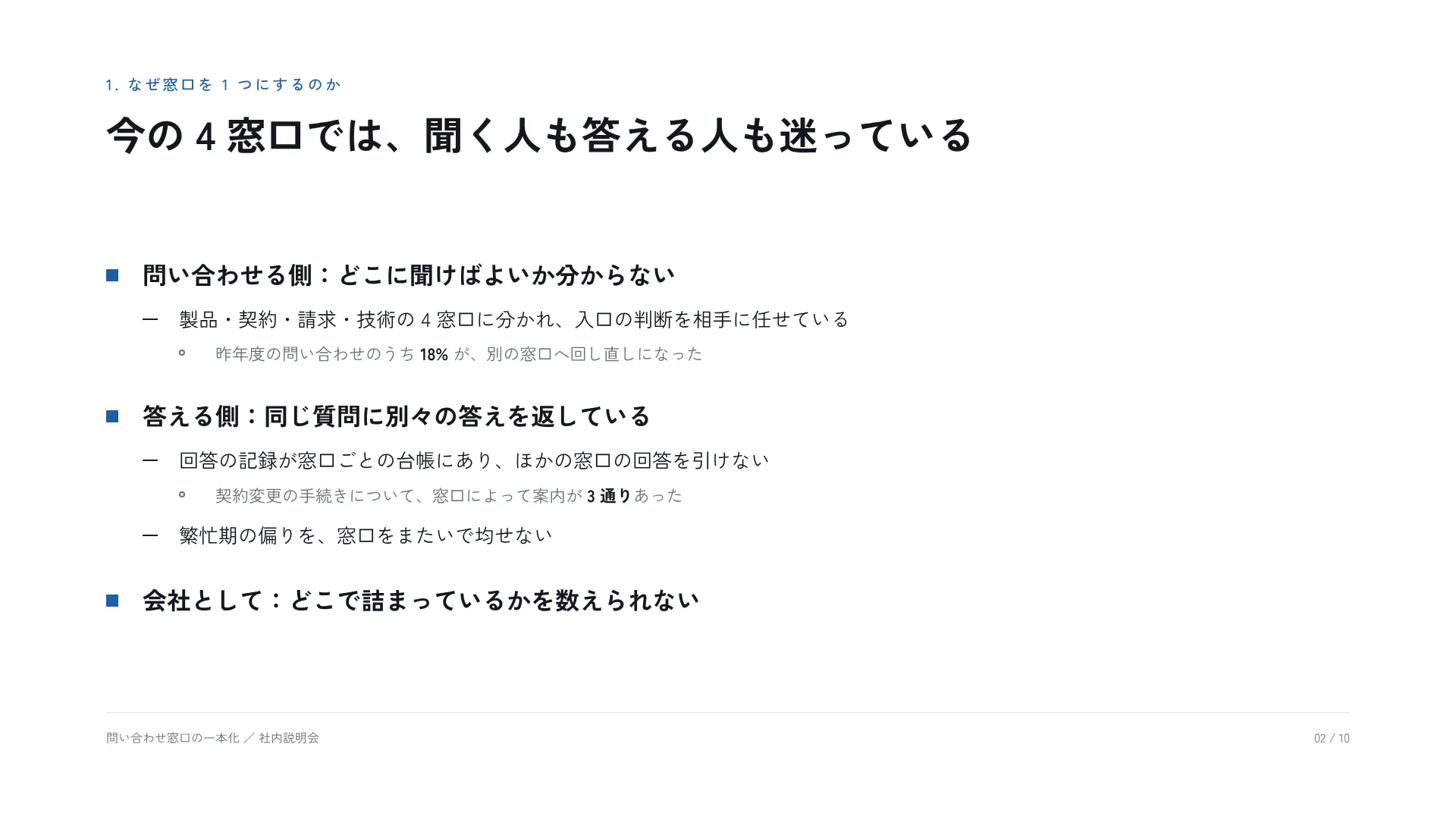
# Three-Level Bullets — Each Level Gets Its Own Mark and Size
Produce one slide to the following specification.

- Canvas 1920 × 1080
- Margin top 96 right 140 bottom 96 left 140

## Type (px against a 1920px canvas)
kicker  20px / 500 / tracking 0.16em
title  52px / 700 / leading 1.35
t1  32px / 700 / leading 1.5
t2  26px / 400 / leading 1.6
t3  22px / 400 / leading 1.6
folio  16px / 400 / tabular numerals

## Colour
Ground #FFFFFF / Surface #F4F6F9 / Ink #131820 / Muted #667183 / Accent #1F5FA8 / Rule #DBE1E9

## Constraints — dropping these breaks it
- Three levels at most — if a fourth is needed, that branch becomes its own slide
- Change mark, size and colour per level — with only one of them, the hierarchy disappears from the back of the room
- Indent on a fixed step (48px), not the width of the mark, so swapping marks never moves the text edge
- Four first-level items at most; figures live on the third level, picked out in bold

Replace the content with [your content]. Keep the measurements and colours as given.
For an exact reproduction, use the verbatim HTML at https://design-vault.pages.dev/designs/bullets-three-levels/pattern.html.

---

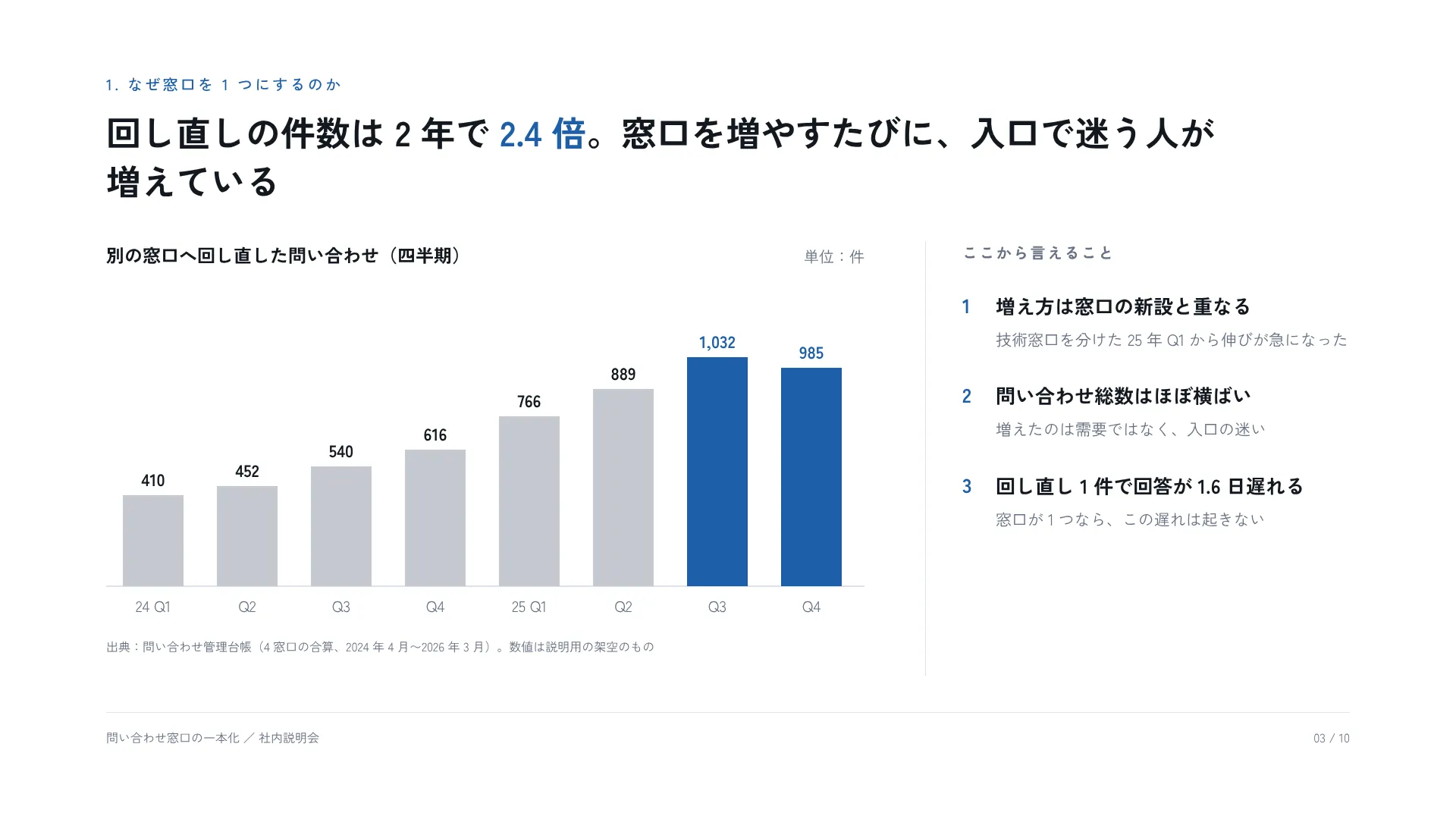
# Action Title with Chart — The Headline States It, the Side Column Adds What Follows
Produce one slide to the following specification.

- Canvas 1920 × 1080
- Margin top 96 right 140 bottom 96 left 140
- 2 equal columns, gap 80

## Type (px against a 1920px canvas)
kicker  20px / 500 / tracking 0.16em
title  46px / 700 / leading 1.4
chartTitle  24px / 700
unit  20px / 400
source  16px / 400
sideLabel  20px / 700 / tracking 0.12em
n  26px / 700 / tabular numerals
pt  26px / 700 / leading 1.5
pd  21px / 400 / leading 1.7
folio  16px / 400 / tabular numerals

## Colour
Ground #FFFFFF / Surface #F4F6F9 / Ink #131820 / Muted #667183 / Accent #1F5FA8 / Rule #DBE1E9

## Constraints — dropping these breaks it
- The headline says what the chart means, not what it is; the chart's title goes small above the plot
- Only the bars the headline points at take the accent; the rest drop to the faintest tone that still reads
- Three takeaways, two lines each — longer than the chart and it is another slide
- Always give the unit and the source — and say so when the numbers are illustrative

Replace the content with [your content]. Keep the measurements and colours as given.
For an exact reproduction, use the verbatim HTML at https://design-vault.pages.dev/designs/action-title-chart-takeaway/pattern.html.

---

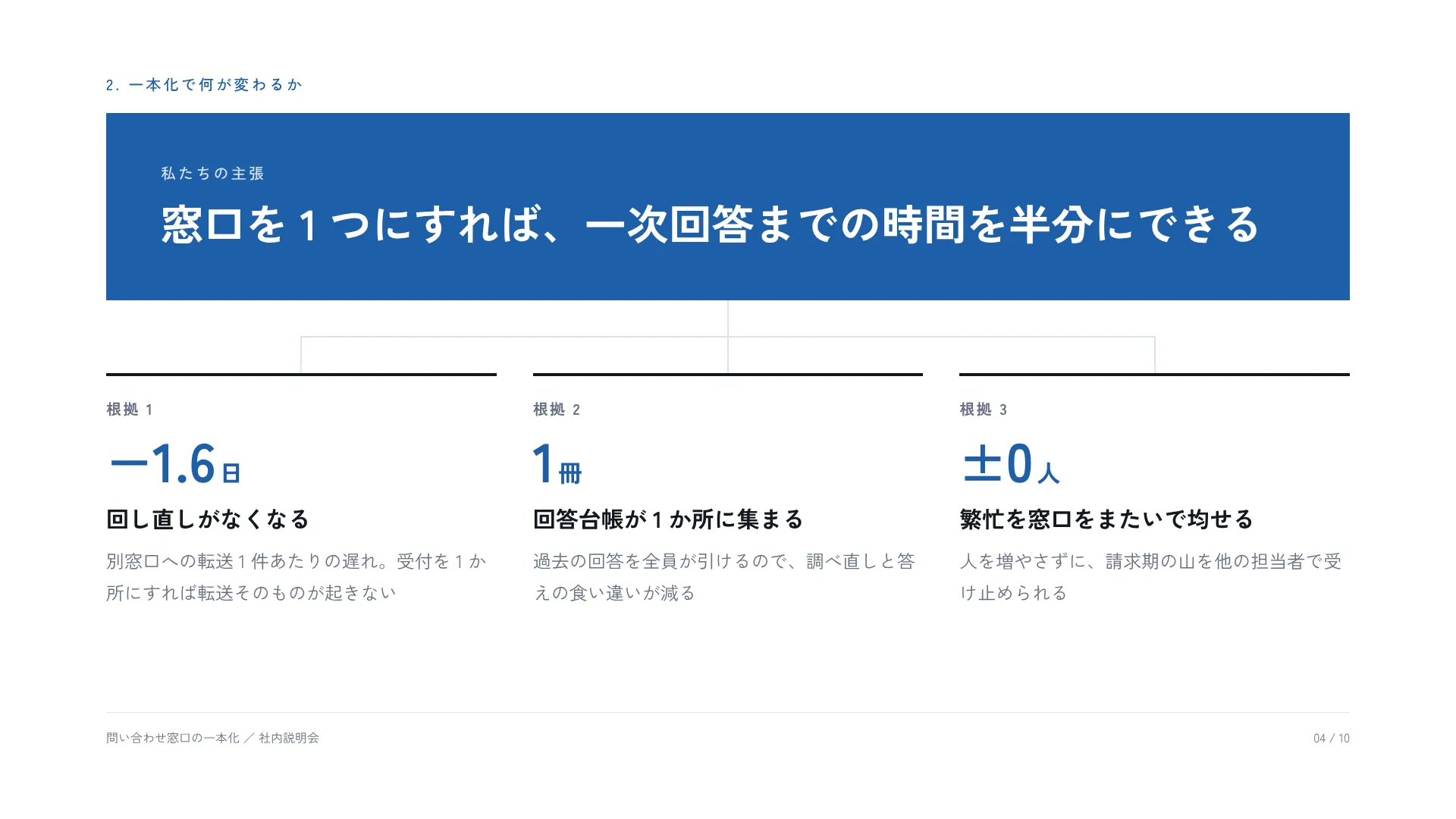
# Key Message with Three Supports — The Claim on Top, Three Reasons Holding It Up
Produce one slide to the following specification.

- Canvas 1920 × 1080
- Margin top 96 right 140 bottom 96 left 140
- 3 equal columns, gap 48

## Type (px against a 1920px canvas)
kicker  20px / 500 / tracking 0.16em
claimLabel  20px / 500 / tracking 0.16em
claimText  56px / 700 / leading 1.4
sLabel  20px / 700 / tracking 0.12em
sFigure  72px / 700 / leading 1.1 / tabular numerals
sHead  30px / 700 / leading 1.5
sBody  24px / 400 / leading 1.75
folio  16px / 400 / tabular numerals

## Colour
Ground #FFFFFF / Surface #F4F6F9 / Ink #131820 / Muted #667183 / Accent #1F5FA8 / Rule #DBE1E9

## Constraints — dropping these breaks it
- Box the claim and give it its own layer — on the same ground it reads as a fourth item
- Three supports: two is thin, four is not remembered
- Each support carries one figure — without one, a support is the claim reworded
- Draw the lines down from the claim; placed side by side, they do not read as holding it up

Replace the content with [your content]. Keep the measurements and colours as given.
For an exact reproduction, use the verbatim HTML at https://design-vault.pages.dev/designs/key-message-three-supports/pattern.html.

---

# Half-Bleed Figure — The Left Half Is the Picture, the Right Half the Text
Produce one slide to the following specification.

- Canvas 1920 × 1080
- Margin top 0 right 0 bottom 0 left 0
- 2 equal columns, gap 0

## Type (px against a 1920px canvas)
caption  20px / 400 / leading 1.6
kicker  20px / 500 / tracking 0.16em
title  50px / 700 / leading 1.4
lede  24px / 400 / leading 1.85
fLabel  20px / 500
fValue  26px / 700 / tabular numerals
folio  16px / 400 / tabular numerals

## Colour
Ground #FFFFFF / Surface #F4F6F9 / Ink #131820 / Muted #667183 / Accent #1F5FA8 / Rule #DBE1E9

## Constraints — dropping these breaks it
- Bleed the figure to the edges; margins belong to the text side only
- Put the caption on a band at the foot, never over the picture — it reads whatever photo arrives
- Until a photo exists, three tones of flat shapes stand in for depth — never draw a person or an object
- Three facts, set at the foot; run on after the body they compete with the picture

Replace the content with [your content]. Keep the measurements and colours as given.
For an exact reproduction, use the verbatim HTML at https://design-vault.pages.dev/designs/half-bleed-figure-text/pattern.html.

---

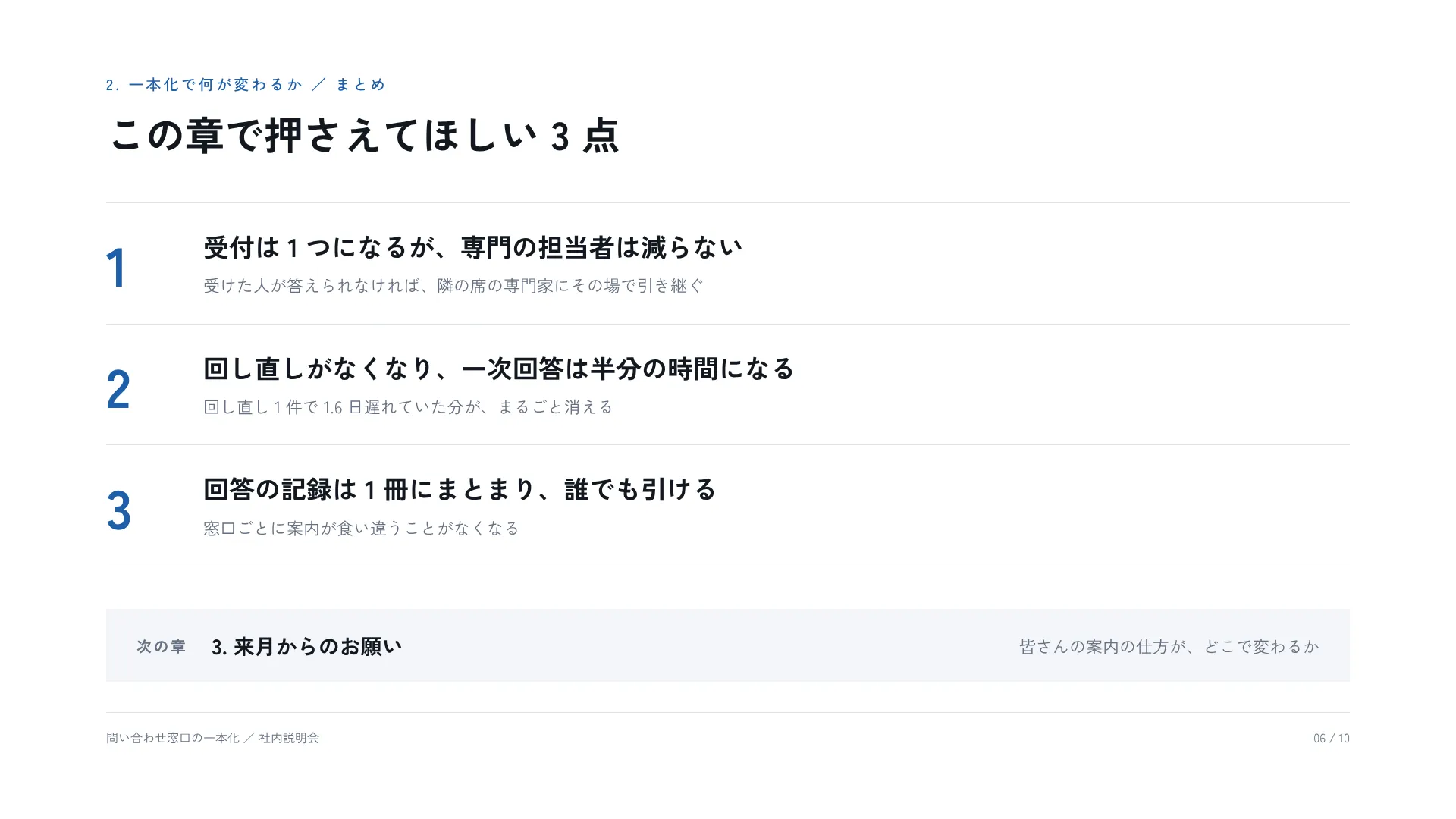
# Chapter Recap — Three Takeaways and a Bridge to What Comes Next
Produce one slide to the following specification.

- Canvas 1920 × 1080
- Margin top 96 right 140 bottom 96 left 140

## Type (px against a 1920px canvas)
kicker  20px / 500 / tracking 0.16em
title  52px / 700 / leading 1.35
n  72px / 700 / leading 1 / tabular numerals
state  34px / 700 / leading 1.45
back  22px / 400 / leading 1.7
nextLabel  20px / 700 / tracking 0.12em
nextTitle  28px / 700
nextWhat  22px / 400
folio  16px / 400 / tabular numerals

## Colour
Ground #FFFFFF / Surface #F4F6F9 / Ink #131820 / Muted #667183 / Accent #1F5FA8 / Rule #DBE1E9

## Constraints — dropping these breaks it
- Three takeaways, one sentence each — list the whole chapter and it becomes a table of contents
- Under each, one line of why — so it can be recalled without paging back
- Fence the next chapter in a panel, smaller than the takeaways — at the same size, the next chapter seems to have started

Replace the content with [your content]. Keep the measurements and colours as given.
For an exact reproduction, use the verbatim HTML at https://design-vault.pages.dev/designs/recap-key-takeaways/pattern.html.

---

# Do and Don't — Behaviours in Pairs, Row by Row
Produce one slide to the following specification.

- Canvas 1920 × 1080
- Margin top 96 right 140 bottom 96 left 140
- 2 equal columns, gap 48

## Type (px against a 1920px canvas)
kicker  20px / 500 / tracking 0.16em
title  52px / 700 / leading 1.35
hLabel  30px / 700
say  27px / 700 / leading 1.5
eg  22px / 400 / leading 1.7
folio  16px / 400 / tabular numerals

## Colour
Ground #FFFFFF / Surface #F4F6F9 / Ink #131820 / Muted #667183 / Accent #1F5FA8 / Rule #DBE1E9

## Constraints — dropping these breaks it
- Set both columns in one grid so paired rows share a height — column by column, the pairs come apart
- Grey out the don't side and hollow its mark — at equal weight, the don't is what people remember
- Give each row the actual words in quotes — the name of a behaviour does not put the sentence in anyone's mouth
- Three pairs at most

Replace the content with [your content]. Keep the measurements and colours as given.
For an exact reproduction, use the verbatim HTML at https://design-vault.pages.dev/designs/do-dont-paired/pattern.html.

---

# FAQ — Six Pairs, Questions Bold and Answers Short
Produce one slide to the following specification.

- Canvas 1920 × 1080
- Margin top 96 right 140 bottom 96 left 140
- 2 equal columns, gap 64

## Type (px against a 1920px canvas)
kicker  20px / 500 / tracking 0.16em
title  52px / 700 / leading 1.35
mark  28px / 700 / leading 1.45
q  28px / 700 / leading 1.45
markA  28px / 700 / leading 1.45
a  22px / 400 / leading 1.75
folio  16px / 400 / tabular numerals

## Colour
Ground #FFFFFF / Surface #F4F6F9 / Ink #131820 / Muted #667183 / Accent #1F5FA8 / Rule #DBE1E9

## Constraints — dropping these breaks it
- Write the questions in the asker's words — the sentence actually asked, not a topic heading
- Answer in one sentence, two lines at most — anything longer earns its own slide
- Order by how often it is asked; read down the left column, then the right
- Colour Q and A differently — only Q takes the accent, so a skim follows the questions

Replace the content with [your content]. Keep the measurements and colours as given.
For an exact reproduction, use the verbatim HTML at https://design-vault.pages.dev/designs/faq-question-answer-pairs/pattern.html.

---

# Glossary — Term, Reading, Meaning and First Use, One Row Each
Produce one slide to the following specification.

- Canvas 1920 × 1080
- Margin top 96 right 140 bottom 96 left 140

## Type (px against a 1920px canvas)
kicker  20px / 500 / tracking 0.16em
title  52px / 700 / leading 1.35
th  20px / 500
term  27px / 700
reading  20px / 400 / tracking 0.04em
def  22px / 400 / leading 1.7
where  20px / 500 / tabular numerals
folio  16px / 400 / tabular numerals

## Colour
Ground #FFFFFF / Surface #F4F6F9 / Ink #131820 / Muted #667183 / Accent #1F5FA8 / Rule #DBE1E9

## Constraints — dropping these breaks it
- Define the word as this document uses it — a dictionary definition drifts from the usage
- Give the reading under each term — in-house words are exactly the ones read differently
- Put the first page at the right, so the glossary leads back into the deck
- Sort by the syllabary — in order of appearance, nothing can be looked up

Replace the content with [your content]. Keep the measurements and colours as given.
For an exact reproduction, use the verbatim HTML at https://design-vault.pages.dev/designs/glossary-term-definition/pattern.html.

---

# Closing with Contacts — Thanks, Then a Way In for Later Questions
Produce one slide to the following specification.

- Canvas 1920 × 1080
- Margin top 120 right 200 bottom 96 left 200

## Type (px against a 1920px canvas)
thanks  72px / 700 / tracking 0.04em / leading 1.3
sub  26px / 400 / leading 1.7
cLabel  20px / 500 / tracking 0.12em
cValue  30px / 700 / tabular numerals
cNote  20px / 400 / leading 1.6
folio  16px / 400 / tabular numerals

## Colour
Ground #111722 / Surface #1A2231 / Ink #E9EDF4 / Muted #8894A6 / Accent #5AA2E8 / Rule #2B3445

## Constraints — dropping these breaks it
- Three contacts at most, ordered urgent, then reference, then a person
- Say when and how fast each one answers — a bare address does not tell anyone which to use
- Draw only the three finder squares for the code frame — never a pattern that would actually scan
- No request or decision here — that is the previous slide's job

Replace the content with [your content]. Keep the measurements and colours as given.
For an exact reproduction, use the verbatim HTML at https://design-vault.pages.dev/designs/closing-thanks-contact/pattern.html.
# Speaker Profile — A Portrait Frame and Only the Career That Earns the Talk
format: slide-16x9
density: medium
layout:
  kind: 2-column
  canvas:
    w: 1920
    h: 1080
  margin:
    top: 96
    right: 140
    bottom: 96
    left: 140
  columns:
    count: 2
    gap: 96
type:
  kicker:
    size: 20
    weight: 500
    tracking: 0.16em
  name:
    size: 64
    weight: 700
    tracking: 0.06em
    leading: 1.2
  reading:
    size: 22
    weight: 400
    tracking: 0.12em
  role:
    size: 26
    weight: 500
    leading: 1.6
  year:
    size: 22
    weight: 500
    numeric: tabular
  what:
    size: 24
    weight: 400
    leading: 1.6
  todayLabel:
    size: 20
    weight: 700
  todayText:
    size: 22
    weight: 400
    leading: 1.7
  folio:
    size: 16
    weight: 400
    numeric: tabular
colors:
  ground: "#FFFFFF"
  surface: "#F4F6F9"
  ink: "#131820"
  muted: "#667183"
  accent: "#1F5FA8"
  rule: "#DBE1E9"
rules:
  - Three career lines at most, chosen for today's talk — turn it into a CV and the audience reads a life instead of a reason to listen
  - The portrait frame is 4:5 with the eyes on the upper third. Until a photo exists, shapes show the ratio and crop — never a drawn person
  - Put the reading under the name, so nobody mispronounces it for the whole talk
  - End with one line on today's topic, so the introduction hands over to the talk

---

# Three-Level Bullets — Each Level Gets Its Own Mark and Size
format: slide-16x9
density: medium
layout:
  kind: stack
  canvas:
    w: 1920
    h: 1080
  margin:
    top: 96
    right: 140
    bottom: 96
    left: 140
type:
  kicker:
    size: 20
    weight: 500
    tracking: 0.16em
  title:
    size: 52
    weight: 700
    leading: 1.35
  t1:
    size: 32
    weight: 700
    leading: 1.5
  t2:
    size: 26
    weight: 400
    leading: 1.6
  t3:
    size: 22
    weight: 400
    leading: 1.6
  folio:
    size: 16
    weight: 400
    numeric: tabular
colors:
  ground: "#FFFFFF"
  surface: "#F4F6F9"
  ink: "#131820"
  muted: "#667183"
  accent: "#1F5FA8"
  rule: "#DBE1E9"
rules:
  - Three levels at most — if a fourth is needed, that branch becomes its own slide
  - Change mark, size and colour per level — with only one of them, the hierarchy disappears from the back of the room
  - Indent on a fixed step (48px), not the width of the mark, so swapping marks never moves the text edge
  - Four first-level items at most; figures live on the third level, picked out in bold

---

# Action Title with Chart — The Headline States It, the Side Column Adds What Follows
format: slide-16x9
density: medium
layout:
  kind: 2-column
  canvas:
    w: 1920
    h: 1080
  margin:
    top: 96
    right: 140
    bottom: 96
    left: 140
  columns:
    count: 2
    gap: 80
type:
  kicker:
    size: 20
    weight: 500
    tracking: 0.16em
  title:
    size: 46
    weight: 700
    leading: 1.4
  chartTitle:
    size: 24
    weight: 700
  unit:
    size: 20
    weight: 400
  source:
    size: 16
    weight: 400
  sideLabel:
    size: 20
    weight: 700
    tracking: 0.12em
  n:
    size: 26
    weight: 700
    numeric: tabular
  pt:
    size: 26
    weight: 700
    leading: 1.5
  pd:
    size: 21
    weight: 400
    leading: 1.7
  folio:
    size: 16
    weight: 400
    numeric: tabular
colors:
  ground: "#FFFFFF"
  surface: "#F4F6F9"
  ink: "#131820"
  muted: "#667183"
  accent: "#1F5FA8"
  rule: "#DBE1E9"
rules:
  - The headline says what the chart means, not what it is; the chart's title goes small above the plot
  - Only the bars the headline points at take the accent; the rest drop to the faintest tone that still reads
  - Three takeaways, two lines each — longer than the chart and it is another slide
  - Always give the unit and the source — and say so when the numbers are illustrative

---

# Key Message with Three Supports — The Claim on Top, Three Reasons Holding It Up
format: slide-16x9
density: medium
layout:
  kind: 3-column
  canvas:
    w: 1920
    h: 1080
  margin:
    top: 96
    right: 140
    bottom: 96
    left: 140
  columns:
    count: 3
    gap: 48
type:
  kicker:
    size: 20
    weight: 500
    tracking: 0.16em
  claimLabel:
    size: 20
    weight: 500
    tracking: 0.16em
  claimText:
    size: 56
    weight: 700
    leading: 1.4
  sLabel:
    size: 20
    weight: 700
    tracking: 0.12em
  sFigure:
    size: 72
    weight: 700
    leading: 1.1
    numeric: tabular
  sHead:
    size: 30
    weight: 700
    leading: 1.5
  sBody:
    size: 24
    weight: 400
    leading: 1.75
  folio:
    size: 16
    weight: 400
    numeric: tabular
colors:
  ground: "#FFFFFF"
  surface: "#F4F6F9"
  ink: "#131820"
  muted: "#667183"
  accent: "#1F5FA8"
  rule: "#DBE1E9"
rules:
  - Box the claim and give it its own layer — on the same ground it reads as a fourth item
  - "Three supports: two is thin, four is not remembered"
  - Each support carries one figure — without one, a support is the claim reworded
  - Draw the lines down from the claim; placed side by side, they do not read as holding it up

---

# Half-Bleed Figure — The Left Half Is the Picture, the Right Half the Text
format: slide-16x9
density: low
layout:
  kind: full-bleed
  canvas:
    w: 1920
    h: 1080
  margin:
    top: 0
    right: 0
    bottom: 0
    left: 0
  columns:
    count: 2
    gap: 0
type:
  caption:
    size: 20
    weight: 400
    leading: 1.6
  kicker:
    size: 20
    weight: 500
    tracking: 0.16em
  title:
    size: 50
    weight: 700
    leading: 1.4
  lede:
    size: 24
    weight: 400
    leading: 1.85
  fLabel:
    size: 20
    weight: 500
  fValue:
    size: 26
    weight: 700
    numeric: tabular
  folio:
    size: 16
    weight: 400
    numeric: tabular
colors:
  ground: "#FFFFFF"
  surface: "#F4F6F9"
  ink: "#131820"
  muted: "#667183"
  accent: "#1F5FA8"
  rule: "#DBE1E9"
rules:
  - Bleed the figure to the edges; margins belong to the text side only
  - Put the caption on a band at the foot, never over the picture — it reads whatever photo arrives
  - Until a photo exists, three tones of flat shapes stand in for depth — never draw a person or an object
  - Three facts, set at the foot; run on after the body they compete with the picture

---

# Chapter Recap — Three Takeaways and a Bridge to What Comes Next
format: slide-16x9
density: low
layout:
  kind: stack
  canvas:
    w: 1920
    h: 1080
  margin:
    top: 96
    right: 140
    bottom: 96
    left: 140
type:
  kicker:
    size: 20
    weight: 500
    tracking: 0.16em
  title:
    size: 52
    weight: 700
    leading: 1.35
  n:
    size: 72
    weight: 700
    leading: 1
    numeric: tabular
  state:
    size: 34
    weight: 700
    leading: 1.45
  back:
    size: 22
    weight: 400
    leading: 1.7
  nextLabel:
    size: 20
    weight: 700
    tracking: 0.12em
  nextTitle:
    size: 28
    weight: 700
  nextWhat:
    size: 22
    weight: 400
  folio:
    size: 16
    weight: 400
    numeric: tabular
colors:
  ground: "#FFFFFF"
  surface: "#F4F6F9"
  ink: "#131820"
  muted: "#667183"
  accent: "#1F5FA8"
  rule: "#DBE1E9"
rules:
  - Three takeaways, one sentence each — list the whole chapter and it becomes a table of contents
  - Under each, one line of why — so it can be recalled without paging back
  - Fence the next chapter in a panel, smaller than the takeaways — at the same size, the next chapter seems to have started

---

# Do and Don't — Behaviours in Pairs, Row by Row
format: slide-16x9
density: medium
layout:
  kind: 2-column
  canvas:
    w: 1920
    h: 1080
  margin:
    top: 96
    right: 140
    bottom: 96
    left: 140
  columns:
    count: 2
    gap: 48
type:
  kicker:
    size: 20
    weight: 500
    tracking: 0.16em
  title:
    size: 52
    weight: 700
    leading: 1.35
  hLabel:
    size: 30
    weight: 700
  say:
    size: 27
    weight: 700
    leading: 1.5
  eg:
    size: 22
    weight: 400
    leading: 1.7
  folio:
    size: 16
    weight: 400
    numeric: tabular
colors:
  ground: "#FFFFFF"
  surface: "#F4F6F9"
  ink: "#131820"
  muted: "#667183"
  accent: "#1F5FA8"
  rule: "#DBE1E9"
rules:
  - Set both columns in one grid so paired rows share a height — column by column, the pairs come apart
  - Grey out the don't side and hollow its mark — at equal weight, the don't is what people remember
  - Give each row the actual words in quotes — the name of a behaviour does not put the sentence in anyone's mouth
  - Three pairs at most

---

# FAQ — Six Pairs, Questions Bold and Answers Short
format: slide-16x9
density: high
layout:
  kind: grid
  canvas:
    w: 1920
    h: 1080
  margin:
    top: 96
    right: 140
    bottom: 96
    left: 140
  columns:
    count: 2
    gap: 64
type:
  kicker:
    size: 20
    weight: 500
    tracking: 0.16em
  title:
    size: 52
    weight: 700
    leading: 1.35
  mark:
    size: 28
    weight: 700
    leading: 1.45
  q:
    size: 28
    weight: 700
    leading: 1.45
  markA:
    size: 28
    weight: 700
    leading: 1.45
  a:
    size: 22
    weight: 400
    leading: 1.75
  folio:
    size: 16
    weight: 400
    numeric: tabular
colors:
  ground: "#FFFFFF"
  surface: "#F4F6F9"
  ink: "#131820"
  muted: "#667183"
  accent: "#1F5FA8"
  rule: "#DBE1E9"
rules:
  - Write the questions in the asker's words — the sentence actually asked, not a topic heading
  - Answer in one sentence, two lines at most — anything longer earns its own slide
  - Order by how often it is asked; read down the left column, then the right
  - Colour Q and A differently — only Q takes the accent, so a skim follows the questions

---

# Glossary — Term, Reading, Meaning and First Use, One Row Each
format: slide-16x9
density: high
layout:
  kind: table
  canvas:
    w: 1920
    h: 1080
  margin:
    top: 96
    right: 140
    bottom: 96
    left: 140
type:
  kicker:
    size: 20
    weight: 500
    tracking: 0.16em
  title:
    size: 52
    weight: 700
    leading: 1.35
  th:
    size: 20
    weight: 500
  term:
    size: 27
    weight: 700
  reading:
    size: 20
    weight: 400
    tracking: 0.04em
  def:
    size: 22
    weight: 400
    leading: 1.7
  where:
    size: 20
    weight: 500
    numeric: tabular
  folio:
    size: 16
    weight: 400
    numeric: tabular
colors:
  ground: "#FFFFFF"
  surface: "#F4F6F9"
  ink: "#131820"
  muted: "#667183"
  accent: "#1F5FA8"
  rule: "#DBE1E9"
rules:
  - Define the word as this document uses it — a dictionary definition drifts from the usage
  - Give the reading under each term — in-house words are exactly the ones read differently
  - Put the first page at the right, so the glossary leads back into the deck
  - Sort by the syllabary — in order of appearance, nothing can be looked up

---

# Closing with Contacts — Thanks, Then a Way In for Later Questions
format: slide-16x9
density: low
layout:
  kind: centered
  canvas:
    w: 1920
    h: 1080
  margin:
    top: 120
    right: 200
    bottom: 96
    left: 200
type:
  thanks:
    size: 72
    weight: 700
    tracking: 0.04em
    leading: 1.3
  sub:
    size: 26
    weight: 400
    leading: 1.7
  cLabel:
    size: 20
    weight: 500
    tracking: 0.12em
  cValue:
    size: 30
    weight: 700
    numeric: tabular
  cNote:
    size: 20
    weight: 400
    leading: 1.6
  folio:
    size: 16
    weight: 400
    numeric: tabular
colors:
  ground: "#111722"
  surface: "#1A2231"
  ink: "#E9EDF4"
  muted: "#8894A6"
  accent: "#5AA2E8"
  rule: "#2B3445"
rules:
  - Three contacts at most, ordered urgent, then reference, then a person
  - Say when and how fast each one answers — a bare address does not tell anyone which to use
  - Draw only the three finder squares for the code frame — never a pattern that would actually scan
- No request or decision here — that is the previous slide's job  Speaker Profile — A Portrait Frame and Only the Career That Earns the Talk
 Three-Level Bullets — Each Level Gets Its Own Mark and Size
 Action Title with Chart — The Headline States It, the Side Column Adds What Follows
 Key Message with Three Supports — The Claim on Top, Three Reasons Holding It Up
 Half-Bleed Figure — The Left Half Is the Picture, the Right Half the Text
 Chapter Recap — Three Takeaways and a Bridge to What Comes Next
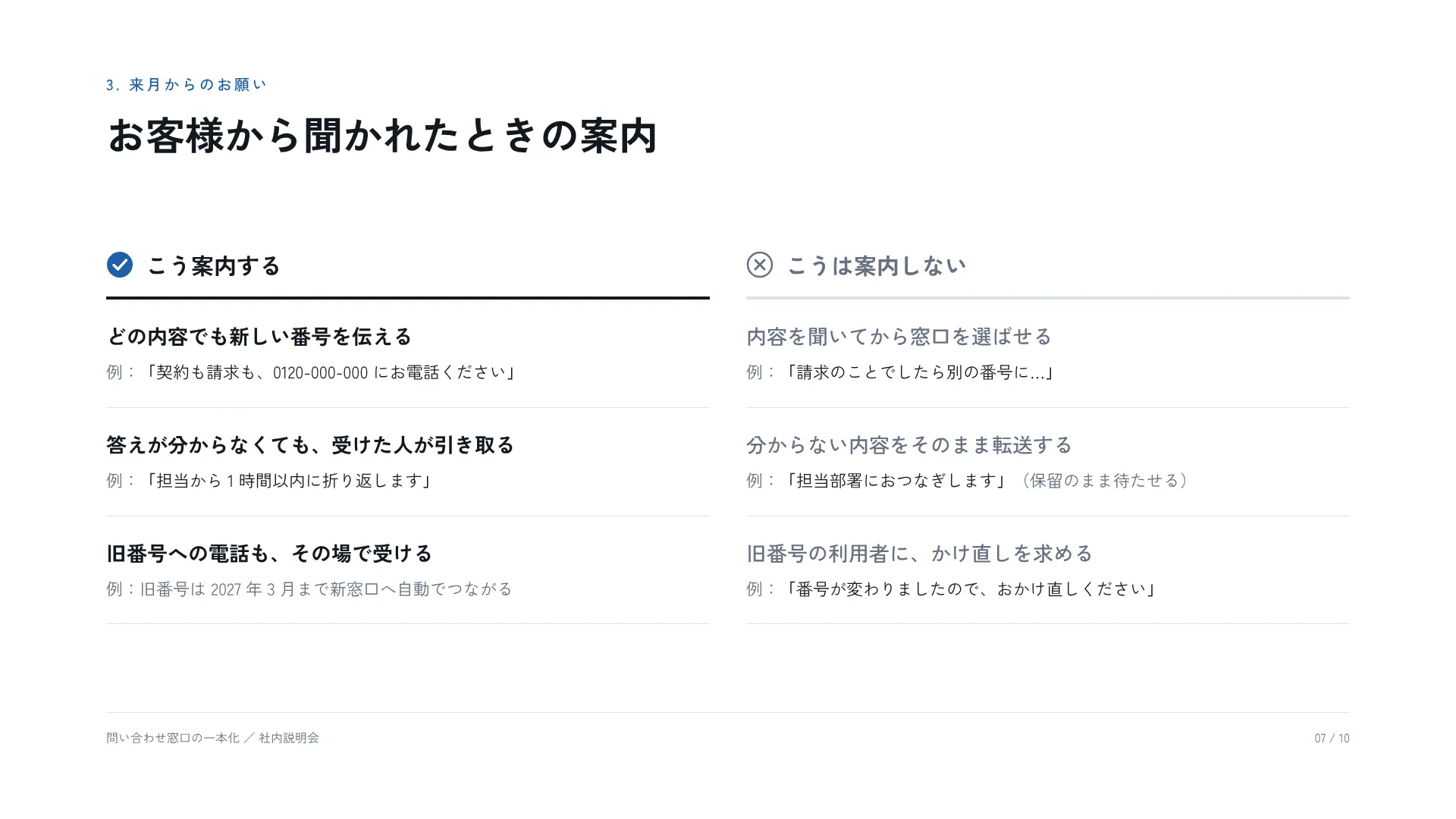 Do and Don't — Behaviours in Pairs, Row by Row
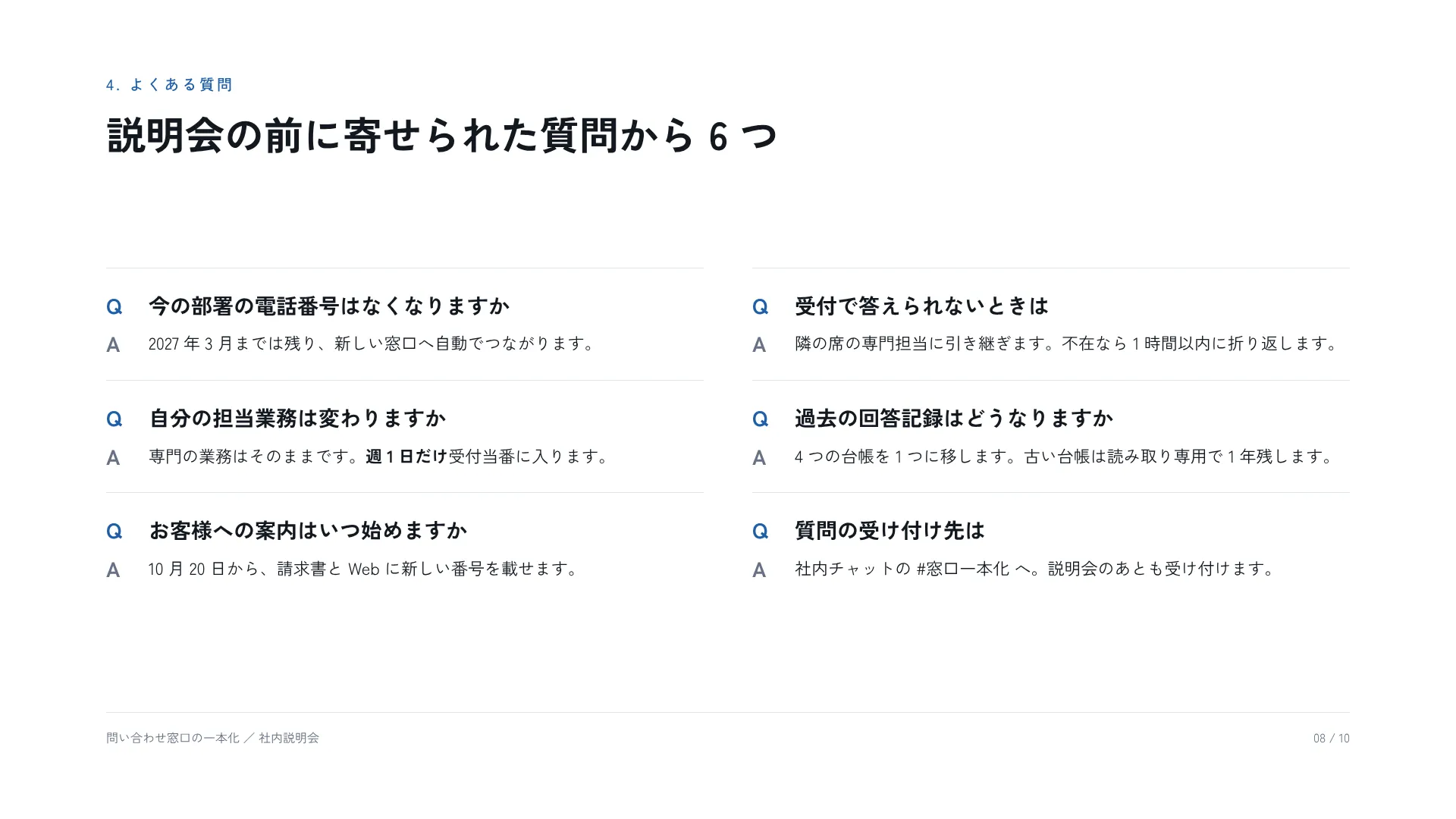 FAQ — Six Pairs, Questions Bold and Answers Short
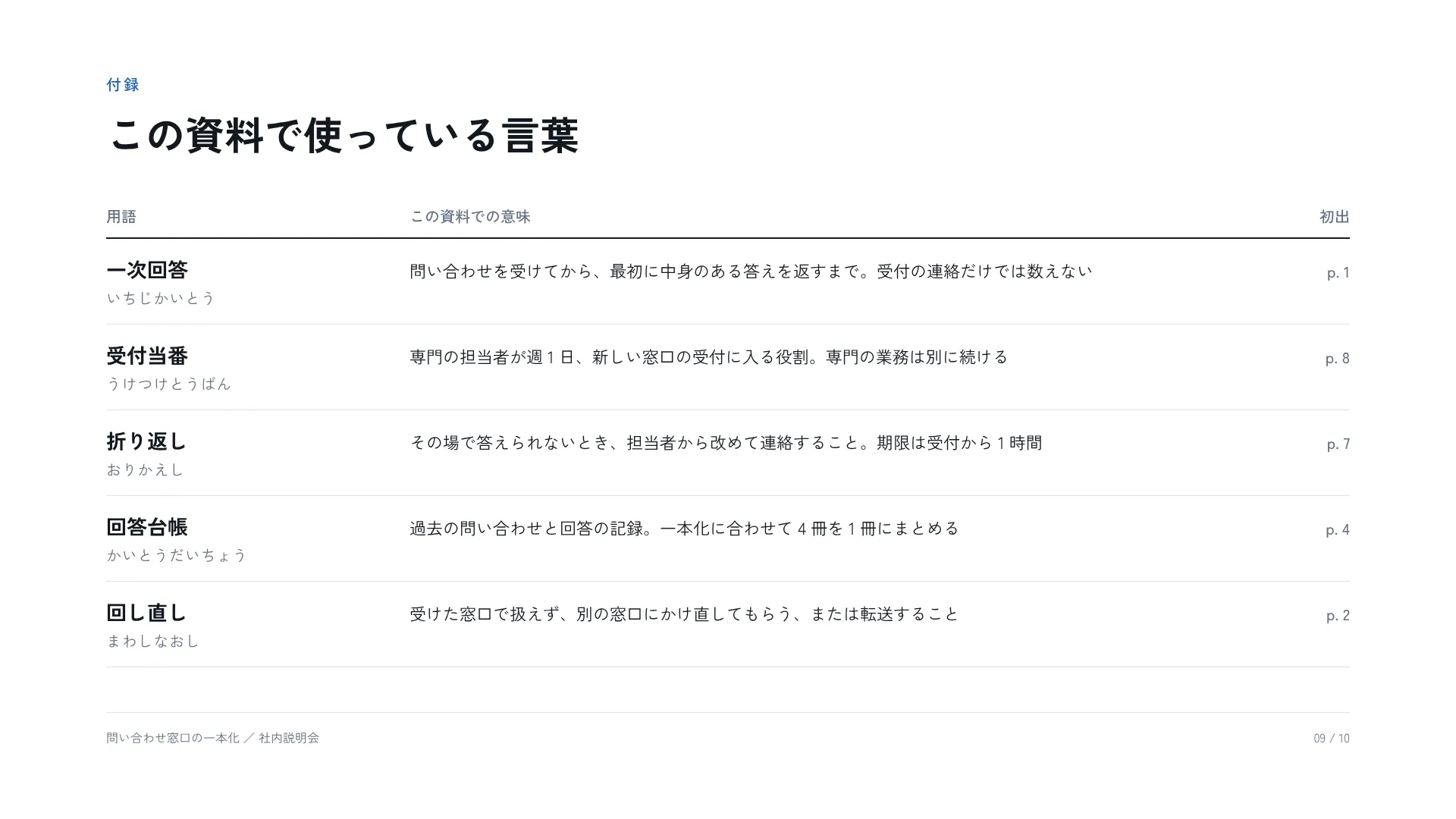 Glossary — Term, Reading, Meaning and First Use, One Row Each
 Closing with Contacts — Thanks, Then a Way In for Later Questions